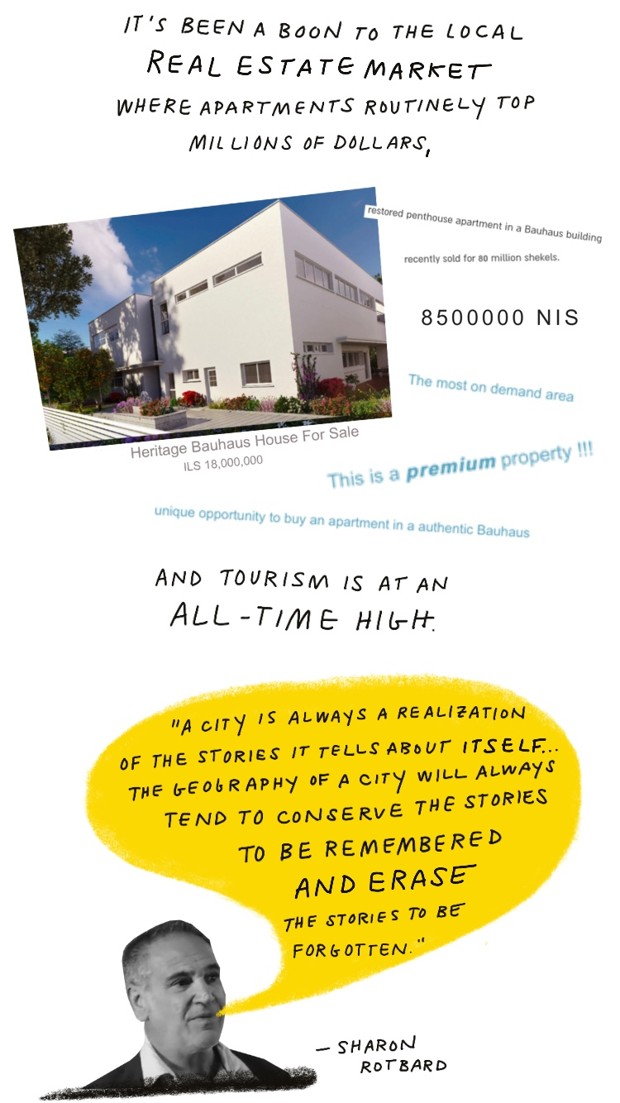
If Tel Aviv’s history is a story of sanctuary and self-isolation, then its buildings designed in the Bauhaus style are monuments to just that. For CityLab’s Building Bauhaus special report, visual storyteller Ariel Aberg-Riger explains how Tel Aviv’s concentration of Bauhausarchitecture came to be and what it represents today. (https://www.citylab.com/design/2019/03/tel-aviv-history-white-city-bauhaus-architecture-buildings/584872/)
Showing posts with label Reviews. Show all posts
Wednesday, May 29, 2019
Ariel Aberg-RIiger / Unpacking Tel Aviv’s White City (Citylab, March 2019)
Labels:
Reviews
Tuesday, November 1, 2016
מיכאל קרוטיקאָוו / דער פֿינצטערער אמת וועגן דער „ווײַסער שטאָט‟, פארווערטס, 30/10/2016
Michael Krutikov / The Dark Truth About the "White City" (Jewish Daily Forward, 30 October, 2016)
http://yiddish.forward.com/articles/200196/the-dark-truth-about-the-white-city/
דער ישׂראלדיקער אַרכיטעקט שרון ראָטבאַרד איז אַ שאַרפֿער קריטיקער פֿון דער פּאָפּולערער מיטאָלאָגיע פֿון תּל־אָבֿיבֿ, די שטאָט װאָס איז כּלומרשט אַנטשטאַנען װי אַ יש מאין אױפֿן זאַמדיקן ברעג פֿונעם מיטללענדישן ים. די דאָזיקע מיטאָלאָגיע שטעלט די „װײַסע שטאָט‟ תּל־אָבֿיבֿ, דעם סימבאָל פֿון דער װעלטלעכער מאָדערנקײט פֿון דער ייִדישער מדינה, אַנטקעגן דעם אוראַלטן „גאָלדענעם‟ ירושלים. מען שטעלט תּל־אָבֿיבֿ פֿאָר װי די אײנציקע שטאָט, װאָס איז אין גאַנצן אױפֿגעבױט געװאָרן אינעם מאָדערנעם פֿונקציאָנעלן סטיל פֿון „באַוהאַוס‟. נאָך דעם װי די נאַציסטן האָבן אַרױסגעטריבן די אָנהענגער פֿון דער דאָזיקער שיטה פֿון דײַטשלאַנד, האָבן זײ געפֿונען אַ מקום־מקלט אין ארץ־ישׂראל.
אָבער די געשיכטע איז געװען מער קאָמפּליצירט, דערװײַזט ראָטבאַרד. תּל־אָבֿיבֿ פֿאַרמאָגט אַ גאַנץ געמיש פֿון פֿאַרשידענע מאָדערנע סטילן, און דװקא „באַוהאַוס‟ איז דאָ פֿאָרגעשטעלט אין זײער אַ באַשײדענער מאָס. די שטאָט איז פֿאַרפּלאַנירט געװאָרן דורך אַ שאָטלענדישן אַרכיטעקט פּאַטריק געדעס אין אַ בריטישן קאָלאָניאַלן נוסח. בכּלל, באַמערקט ראָטבאַרד סאַרקאַסטיש, האָט די בריטישע קאָלאָניאַלע אַדמיניסטראַציע אױפֿגעטאָן מער פֿאַרן אַנטװיקלען די אינפֿראַ־סטרוקטור פֿון ארץ־ישׂראל אײדער די רעגירונג פֿון מדינת־ישׂראל. די מאַנדאַט־תּקופֿה האָט איבערגעלאָזט נאָך זיך דאָס פֿליפֿעלד אין לוד, דעם תּל־אָבֿיבֿער פּאָרט, די אײַזנבאַן, שאָסײען און קאָמוניקאַציעס, װאָס פֿונקציאָנירן עד־היום.
אָבער די סאַמע שאַרפֿע קריטיק זײַנע װענדט ראָטבאַרד קעגן דער פּלאַנמעסיקער צעשטערונג פֿון דער שטאָט יפֿו, װאָס האָט אין משך פֿון טױזנטער יאָרן געדינט װי אַ ים־טױער אין ארץ־ישׂראל. גאַנצע געגנטן פֿונעם אַראַבישן יפֿו זײַנען חרובֿ געװאָרן נאָך דער אומאָפּהענגיקײט־מלחמה אין די 1950ער, װען די אַלטע שטאָט איז אױפֿגעשלונגען געװאָרן דורך איר יונגן צפֿונדיקן שכן. קײן זכר פֿונעם אַלטן אַראַבישן יפֿו איז ניט פֿאַרבליבן, און אַפֿילו די שטאָטישע אַרכיװן זײַנען פֿאַרברענט געװאָרן. מען האָט געמאַכט פֿון יפֿו אַ מין טעמאַטישן פּאַרק מיט אַ בולטן טראָפּ אױף דער תּקופֿה פֿון קרײצצוגן, װאָס באַטאָנט נאָך אַ מאָל דעם „אײראָפּעיִשן‟ מהות פֿון דער שטאָט.
ראָטבאַרדס בוך איז לחתּחילה אָנגעשריבן געװאָרן אױף עּבֿרית און באַצװעקט פֿאַרן ישׂראלדיקן עולם. זײַן כּװנה איז אױפֿצוּװעקן דאָס שולדגעפֿיל בײַ די ישׂראלדיקע לינקע. ער באַװײַזט, אַז אַפֿילו אַ קריטישער ציוניסטישער קוק אױף דער געשיכטע פֿון מדינת־ישׂראל פֿאַרשװײַגט װיכטיקע חטאים. זײַן סך־הכּל איז גאַנץ קאַטעגאָריש׃ ייִדן זענען יאָ באַגאַנגען שװערע פֿאַרברעכנס לגבי די אַראַבער, און איצט װילן זײ אױסמעקן דעם זכר פֿונעם רײַכן אַראַבישן עבֿר פֿון דער לאַנדשאַפֿט פֿון תּל־אָבֿיבֿ. די פֿאַקטן און טעכנישע פּרטים אין ראָטבאַרדס בוך רעדן פֿאַר זיך, הגם ער כאַפּט צומאָל איבער דער מאָס אין זײַנע פּאָלעמישע אױספֿירן פֿון די דאָזיקע פֿאַקטן און פּרטים. אָבער זײַן טעזיס קלינגט גאַנץ װאָגיק און לאָזט זיך ניט אַװעקמאַכן מיט דער האַנט.
װאָס זשע טוט מען מיט אַזאַ „שלעכטן געװיסן‟? װי אַזױ קאָן מען זיך באַגײן מיט די פֿינצטערע זײַטן פֿון דער ישׂראלדיקער געשיכטע? עס איז ניטאָ קײן פּראָסטער ענטפֿער אױף דער דאָזיקער פֿראַגע, אָבער עס איז כּדאי אַרײַנצוקוקן זיך נעענטער אין דער פֿראַגע־שטעלונג גופֿא. דער ענין פֿונעם היסטאָרישן שולד איז ניט קײן המצאָה פֿון די ישׂראלדיקע לינקע. דאָס איז אַ האַרבע קשיא אין מיזרח־אײראָפּע, און דװקא בנוגע דעם אָנטײל פֿון אָרטיקע מענטשן אינעם חורבן. דער פּױלישער דענקער אַנדזשײ לעדער טענהט, אַז די הײַנטיקע פּױלישע געזעלשאַפֿט האָט דערשטיקט דעם אָנדענק װעגן אומגעבראַכטע ייִדן, װײַל דער פּױלישער מיטלשטאַנד האָט נאָך דער מלחמה מרװיח געװען פֿון דעם ייִדישן האָב־און־גוטס און האָט פֿאַרנומען זײער אָרט אין דער געזעלשאַפֿט.
אָבער װי אַזױ קאָן מען פֿאַרגלײַכן דעם חורבן מיט דער מלחמה פֿאַר מדינת־ישׂראל? אַװדאי טאָר מען זײ ניט מעסטן מיט דער אײגענער מאָראַלישער מאָס, אָבער װען אַ פּראָבלעם װערט דערמאָנט, דאַרף מען זי אַזױ אָדער אַנדערש לײזן.
די דאָזיקע פּראָבלעם האָט נאָך אַן אַנדערן אַספּעקט. עס איז הײַנט גרינג מכבד צו זײַן די ייִדישע קולטור אין פּױלן און דעם „בײַטראָג‟ פֿון ייִדן אין דער פּױלישער קולטור, װאָרן מען קאָן זײַן זיכער, אַז ייִדן האָבן ניט אין זינען זיך אומצוקערן קײן פּױלן און דערקלערן עס פֿאַר זײער לאַנד. דער מצבֿ איז אַװדאי אַנדערש מיט די אַראַבער און ישׂראל.
די לינקע ישׂראלדיקע אינטעליגענץ נעמט אױף זיך אַ שװערן מאָראַלישן שולד פֿאַרן עבֿר פֿון מדינת־ישׂראל. עס װאָלט געװען כּדאי זיך אַרומצוקוקן, װי אַזױ באַהאַנדלט מען אַזוינע ענינים אין אַנדערע לענדער, און בפֿרט אין מיזרח־אײראָפּע. מדינת־ישׂראל איז לכתּחילה פֿאַרטראַכט געװאָרן לױטן מיזרח־אײראָפּעיִשן שטײגער פֿון אַ נאַציאָנאַלער מלוכה, אַזױ װי פּױלן, ליטע, לעטלאַנד, אָדער רומעניע נאָך דער ערשטער װעלט־מלחמה. דאָס איז געװען די פּאָליטישע מאָדעל, װאָס די אָבֿות פֿון דער ייִדישער מלוכה האָבן גוט געקענט. װי אַלע פּאָליטישע מאָדעלן, האָט זי אירע פּראָבלעמעס, און די גרעסטע פֿון זײ איז דער ענין פֿון מינאָריטעטן. אין מיזרח־אײראָפּע האָט מען די דאָזיקע פּראָבלעם ניט געלײזט, און דאָס איז געװאָרן אײנער פֿון די גורמים פֿון דער צװײטער װעלט־מלחמה. עס איז אַװדאי ניטאָ קײן לײַכטע לײזונג פֿאַר ישׂראל, אָבער עס לױנט זיך צו װיסן, װי אַזױ מען באַהאַנדלט דעם אײגענעם עבֿר אין דער מיזרח־אײראָפּעיִשער „אַלטער הײם‟, װוּ ישׂראל האָט געירשנט זײַן פּאָליטישע טראַדיציע.
Read more: http://yiddish.forward.com/articles/200196/the-dark-truth-about-the-white-city/#ixzz4OkZdriwt
Tuesday, October 25, 2016
Antoine Mandoux / Review (October 2016, Revista Finisterra, LI, 102, Centro de Estudos Geográficos, Lisboa)
«[…] in the problematic political contexts and difficult circumstances of any possible architectural practice anywhere, and especially in Israel, writing has always seemed to me one of the few decent and effective ways to be an architect.» p. 184. «It is not really necessary to state again that the White City will never be white enough – the earth simply does not rotate fast enough.» p. 177.
En 2004, la « Ville blanche de Tel Aviv » est classée au patrimoine mondial de l’UNESCO parce qu’elle est « la synthèse d’une valeur exceptionnelle des diverses tendances du Mouvement moderne en matière d’architecture et d’urbanisme au début du XXe siècle. » Le discours officiel qui a soutenu l’élection de la ville lie intimement la naissance et la croissance de Tel Aviv au Bauhaus et au Style International apportés par les premiers « migrants » juifs venus d’Europe centrale. Si on le suit un peu plus loin, les fondements de la ville reposent sur des dunes de sable blanc, apportant modernité et prospérité à une terre délaissée par ses anciens habitants. Avec « White City/Black City », Sharon Rotbard, architecte israélien, commence une critique systématique de cette véritable hagiographie de l’édification de Tel Aviv à nos jours. Usant de faits historiques et politiques comme d’éléments de la culture populaire, Sharon Rotbard compose morceau à morceau une histoire de l’histoire, le récit du récit dans lequel l’architecture devient un moyen d’écrire la narration et la narration de construire la ville. Concevoir une ville n’est pas un acte anodin et la forme qu’elle prend reflète les valeurs et les aspirations de ses concepteurs et, dans le même mouvement, ces valeurs et aspirations, une fois matérialisés, conditionnent ceux qui la vivent. De cette manière, la conception de Tel Aviv est un projet politique qui relève plus des visées coloniales sionistes et britanniques que de tout autre mythe fondateur. Ne recensant que peu d’édifices construits, encore moins d’architectes israéliens, qui auraient pu être liés au mouvement Bauhaus, le livre révèle que la ville dans sa structure comme dans sa forme doit bien plus au Mandat britannique qu’à tout autre pouvoir en place, même le nouvellement indépendant Etat hébreu. De ce point de vue, Tel Aviv ressemble plus à Casablanca ou Alger, des ensembles urbains modernistes et « européanisés » élaborés par le colonisateur français qu’au projet national ou nationaliste qu’il est censé être. Le pouvoir colonial britannique est le premier – et peut-être le seul – à avoir envisagé la cité et sa région comme un tout et à les avoir redessinées selon leurs intérêts : traçant les axes liant l’arrière-pays au port commercial de Jaffa, ébauchant les structures d’un état moderne, détruisant, divisant ou développant des quartiers urbains pour éviter les révoltes et les troubles. Comme nous le voyons, l’histoire de Tel Aviv est un peu plus complexe que le conte officiel et Sharon Rotbard nous propose dans son style brillant et acerbe de passer de l’autre côté du miroir et de rencontrer la « Ville noire » – encore aujourd’hui les parties les plus sombres et pauvres de la ville. Si la « Ville blanche » repose sur des dunes, la « Ville noire » a été bâtie sur de florissants vergers d’agrumes et les restes de la ville de Jaffa, les uns et les autres ayant fait la renommée de la région. Dès lors, commence le récit passionnant de l’histoire tragique de Jaffa, autrefois l’un des ports les plus prospères de la côte levantine. Du siège sanguinaire par les troupes françaises en 1799 à sa capture et son annexion par le tout neuf Etat hébreu en 1948, l’auteur retrace dans le détail près d’un siècle et demi d’une histoire tumultueuse sur fond de colonialismes britannique et sioniste et de nationalismes arabe et juif. Des premières colonies au début du XXe siècle au projet Homa Umigdal [1], il expose le mouvement d’expansion et d’accaparement du territoire par les nouveaux arrivants, mouvement qui isolera petit à petit Jaffa de son arrière-pays et qui mènera à ce qu’il nomme son « urbicide ». Si Tel Aviv[2]incarne l’aspiration des populations juives à l’indépendance, Jaffa, de par sa position enclavée par le tracé des frontières de novembre 1947, devient le symbole de la cause palestinienne. Des groupes paramilitaires sionistes, Etzel entre autres, se lancent à l’attaque de la ville déjà partiellement détruite et dont une partie de la population a quitté les lieux et ils l’achèveront, elle et ses derniers habitants, alors même que l’indépendance d’Israël est prononcée. Après son annexion au territoire israélien et à la municipalité de Tel Aviv, l’« urbicide » de Jaffa continue en s’attaquant à sa mémoire et à sa matérialité. Le champ de ruines qu’elle est devenue est surnommé « The Big Zone » et sert d’accueil aux nouveaux venus arrivés des pays de l’Est et des pays arabes environnants. Ceux-ci, souvent pauvres, lui donnent une mauvaise réputation, à la fois lieux de tous les trafics et de toutes les libertés. Lâchée aux mains de spéculateurs dans les années 60, le front de mer se hérisse d’hôtels et d’immeubles, des pans entiers de l’ancienne ville sont rasés et reconstruits avec de nouveaux noms, de nouvelles formes et de nouvelles histoires. La nouvelle gare routière est peut-être le signe par lequel la démesure de l’entreprise peut être aperçue : « objet » monolithique d’architecture moderniste dont l’utilité reste encore à prouver. Le musée Etzel est lui aussi un exemple, paradoxe de la politique israélienne : un cube en verre ultra-moderne sur les restes de l’une des dernières maisons jaffoites encore debout et abritant le musée à la gloire des bourreaux de l’ancienne ville arabe... Si des voix s’élèvent au début des années 80 pour défendre et protéger la « Ville blanche », c’est également pour glorifier le progressisme et l’abnégation des premiers colons, souvent issus de familles allemandes ou d’Europe occidentale, porteuses d’un sioniste, socialiste et athée et dont elle serait l’œuvre ; et ce, après la victoire de la droite israélienne aux élections de 1977, partisane d’une colonisation à tout-va et d’un laisser-aller urbanistique et spéculatif dont la « Ville noire » serait le résultat. Si en 2004, la « Ville blanche » est reconnue internationalement pour son architecture moderne, la « Ville noire » est l’objet d’une vaste opération sécuritaire qui aboutira à l’expulsion de 115.000 travailleurs étrangers, soit autant que la population arabe avant 1947. Sharon Rotbard, lui-même installé dans la partie « sombre » de la ville, achève son premier livre par une réflexion plus générale sur l’utilisation de l’architecture comme moyen de domination. Reprenant les principales caractéristiques du modernisme – austérité et efficacité, béton et blancheur, il compare leurs usages dans Tel Aviv à d’autres cas de villes neuves comme Dakar, Alger ou Casablanca, Antoine Mandoux 145 toutes issues de l’imagination d’urbanistes modernistes et qui portent encore aujourd’hui les formes de la domination coloniale. En plus d’être un exposé intelligent de l’histoire de Tel Aviv-Jaffa selon le prisme de l’urbanisme, ce livre, le premier de Sharon Rotbard, laisse les jalons d’une réflexion plus profonde et dans d’autres contextes de l’emploi de l’architecture comme « arme de guerre ».
referências bibliográficas
«White City, Black City» de Sharon Rotbard
[1] Voir « Wall and Tower (Homa Umigdal), the mold of israeli architecture » de Sharon Rotbard, in Rafi Segal, Eyal Weizman, « A civilian occupation, the politics of israeli architecture », Babel/Verso, Tel Aviv/London-New York, 2003.
[2] Tel Aviv signifie en hébreu « Ancienne-Nouvelle Terre », un autre nom de Eretz Israel, la « Terre promise ». C’est également la traduction du roman de Theodore Herzl, fondateur du sioniste, Altneuland publié en 1902.
[1] Voir « Wall and Tower (Homa Umigdal), the mold of israeli architecture » de Sharon Rotbard, in Rafi Segal, Eyal Weizman, « A civilian occupation, the politics of israeli architecture », Babel/Verso, Tel Aviv/London-New York, 2003.
[2] Tel Aviv signifie en hébreu « Ancienne-Nouvelle Terre », un autre nom de Eretz Israel, la « Terre promise ». C’est également la traduction du roman de Theodore Herzl, fondateur du sioniste, Altneuland publié en 1902.
Barbara Mann / Review (October 2016, Quest. Issues in Contemporary Jewish History, n.9)
Cities are notoriously hard to pin down; they are a work in progress, always already both dynamic stage and evolving container of the diverse lives that move in and out of them. Stories about cities are even more slippery. However, just as history is told by the victors, stories about cities, as Sharon Rotbard points out inWhite City, Black City: Architecture and War in Tel Aviv and Jaffa, are also primarily dictated by those powerful economic, political and social forces that have built them. The received history of Tel Aviv in relation to Jaffa – the town from which it emerged, and to which it remains joined at the hyphenated-hip – is the putative subject of Rotbard’s study; however, the book is also a broader investigation of cultural and political identity, and especially how Israeli Jews have negotiated the burdens and responsibilities of national autonomy and regional power.
In the years since Rotbard’s bracing and passionate book first appeared in Hebrew in 2005, scholarship about Tel Aviv-Jaffa has burgeoned.1 Scholars now have a fuller appreciation of the development of Israeli urban space, and Tel Aviv’s and Jaffa’s particular roles therein. Yet White City, Black City still reads like a fresh and necessary corrective – in parts like a slap in the face – mostly due to the fluent urgency of Rotbard’s prose, and the continual visual scrim that accompanies the text. This text-image dance is even more impressive in the original Hebrew version, which was one of the first volumes published by Rotbard’s own independent press, Babel. The book’s narrative folds on the fuzzy, threadbare seam that is the historical boundary between Jaffa and Tel Aviv, a border that – like all borders – is more about political exigencies than physical topography.
The term “white city” stems from the moniker that has shaped discourse about Tel Aviv since the 1980s, and references the city’s abundance of “international style” or Bauhaus constructions from the interwar period. “Black City” is all Rotbard’s invention – though, as he notes, examples may be found all over the world (p. 176). He means the term in the Morrisonian sense: in her classic study of American literature, Playing in the Dark, Toni Morrison argues that it is only against [African-American] black, that [American] whiteness becomes visible; Herman Melville – especially, Moby Dick, with the elusive “whale’s whiteness” – is her grand case study.2 Rotbard’s argument rests on a similar dynamic: beginning in 1909 or so, and moving through the interwar period, Tel Aviv is “born” (or grounds its origins story) as a ring of neighborhoods, essentially gated communities posing as new suburbs – a land grab on the part of a mixed group of Jewish immigrant investors, whose strategy effectively stymied Jaffa’s own urban growth (p. 72 and following, 79-80). Tel Aviv is “born again,” in the 1980s, with the stories with which Israeli architects began to explain the significance of the city’s predominant early architectural style, variously tagged as “International” or Bauhaus. In both instances – “birth” and “rebirth” – Tel Aviv depended on a selective rendering of the facts (e.g. how many Jewish architects working in Palestine in the 1930s really studied at the Bauhaus school in Berlin), and – more profoundly – a particular version of Jaffa for its self-definition, even as it turned a blind eye to, and eventually destroyed, traces of the latter’s physical existence, as well as its presence in historical memory:
“Much more than a physical location boxed in by calcified geographical frontiers, the Black City as a condition. And it is a condition which exists only in relation to the White City. Without it, the Black city is invisible; it is everything hidden by the long, dark shadow of the White City, everything Tel Aviv does not see and everything it does not want to see.”3
With this historical blindspot, and with Jaffa’s continuing gentrification, Tel Aviv has not only staged itself as Jaffa’s opposite; it has also attempted to erase any evidence of this process. In Rotbard’s view, the “white” version of the city’s origins, which began to emerge in its professional (architectural/municipal/creative/business) classes in the mid-1980s, was eventually embraced by a citizenry longing for a “clean” version of its own beginnings. This version of Tel Aviv’s progressive, liberal origins – its modernity – appealed to a Jewish-Israeli audience grown weary of the nightly television news’ steady diet ofIntifada. It gave them something good to believe in, and strengthened the notion of Tel Aviv as a “bubble,” aloof towards the ongoing violence and political conflict (“the situation”) that so powerfully shapes Israeli life. This narrative reached an apex of sorts in 2003 when Tel Aviv was declared a UNESCO World Heritage Site, for its architectural distinctiveness and abundance of interwar structures, specifically – its “synthesis of…. the various trends of the Modern Movement in architecture and town planning in the early part of the 20th century”.4 There is, as Rotbard suggests, a direct line from the economic windfall of this award to the city’s more recent emergence as a gay-friendly global destination. But before we jump to the present, it is worth lingering on that moment when Tel Aviv happened, and the meaning of its establishment precisely in relation to Europe.
Indeed, the abundance of interwar structures that connect Tel Aviv to its European past, also implicitly recalls the war’s enormous physical destruction and diminishment of Eastern European Jewish life. While, as Rotbard claims “much more than a Zionist project or a Jewish project, Tel Aviv was a white, European project” (p. 142), these same Jewish entrepreneurs also viewed Europe as a negative space, whose broken promises of acculturation and political equity laid the foundation for national aspirations, including – but not only – Zionism. The utopianism of architecture as a tool of social engineering may also shape the enlightenment’s darker side, but Jews have arguably stood on both sides of its dialectic, on both ends of power.
Rotbard himself implicitly raises the Shoah when he introduces the figure of Albert Speer, Hitler’s architect, and the symbolic importance of ruins for a national tradition. Rotbard concludes: “there is no doubt that any building, of any form, is also, by default, a pattern of the destruction which may await it” (p. 131). One could extend this profound statement to the enterprise of Israeliness that seems to be at the center of this book (pp. 35-36). Is there something inherently, “organically” combustible about Jewish national autonomy?
In the years since Rotbard’s book first appeared, groups such as Zochrot – in Tel Aviv-Jaffa and throughout Israel/Palestine – have addressed some of the historical and material lacunae he describes.5 Raising public awareness through publications, public forums and artistic installations that draw attention to physical traces of pre-state Palestinian life in Jaffa and elsewhere, their actions also contextualize the contemporaneous efforts of community organizers in Tel Aviv-Jaffa to create solidarity among historically neglected neighborhoods and their disenfranchised populations. One can only read Tel Aviv-Jaffa’s streets with more open eyes, with a more sober a tread, with Rotbard’s book in hand.
Barbara Mann, Jewish Theological Seminary, New York
[1] See “Tel Aviv at 100: Notes Towards a New Cultural History,” in Jewish Social Studies, 16/2 (2010): 93-110.
[2] On page 52, Rotbard references an interview with Morrison. See Toni Morrison, Playing in the Dark: Whiteness and the Literary Imagination (Cambridge: Harvard University Press, 1992).
[3] White City, Black City, 66.
[4] See Rotbard 2 and http://whc.unesco.org/archive/decrec03.htm#dec8-c-23.
[5] For example, the recent They say there is a land: Guidebook (Sedek/Pardes-Zochrot: Tel Aviv-Jaffa, 2012) [Hebrew-Arabic].
Labels:
Reviews
Monday, April 18, 2016
Jonathan Moses / Whiter than white (CITY Journal, 7 April 2016)
"White City Black City is an important work, demythologising a city whose founding myths service ongoing dispossession and violence. Yet what it removes it struggles to replace, leaving us aware of a loss without much hope for its recovery. The result is a stimulating but dispiriting read: “Tel Aviv is certainly, and today more than ever, a predator city” writes Rotbard in his 2015 afterword, and the borders between the White and Black City might now be found anywhere, “behind your backyard, in the middle of my street, between two kindergarten classes or at the entrance of any nightclub”. Sadly, It is perhaps this, more than any other image in the book, which feels most universally applicable today."
(The entire article can be found here.)
Labels:
Reviews
Monday, December 28, 2015
Shira Wilkof / Review (December 2015, Journal of Levantine Studies)
Since its publication in Hebrew in 2005, White City, Black City: Architecture and War in Tel Aviv and Jaffa has become a part of the canon of critical spatial studies in Israel. This long-awaited English edition is most welcome. The original Hebrew edition was published a year after UNESCO had, because of Tel Aviv’s singular concentration of interwar modernist architecture, declared “The White City of Tel Aviv” a world heritage site.1 Since then two parallel dynamics have taken place. While the brand name “White City” has become a powerful economic and cultural engine, a magnet for global tourism that has dramatically changed the face of the city, the book itself has opened up an important critical avenue into understanding the cultural, political, and urban processes that gave rise to this phenomenon.
Rotbard’s main objective is to debunk the “myth” of the White City of Tel Aviv. The term refers to districts in the center of the city, where the modernist style became predominant. These areas were constructed and settled by European Jewish (Ashkenazi) immigrants during the urban boom of the interwar decades. The “Black City,” by contrast, includes historic Jaffa and the Jewish neighborhoods of south Tel Aviv, where Arabs, Mizrahi Jews, and the working class have traditionally resided.
In a postcolonial Saidian vein (and with a title alluding to Fanon’s Black Skin, White Masks), Rotbard proposes a dual-city model, whereby the two “cities” are conceived of as both geographical realms and mental constructs. The White City is European. Its modernist architecture—flat roofs, white-stuccoed walls, and clean lines—reflects the overarching values of its inhabitants, namely the Ashkenazi-Zionist hegemony, aspiring to European order, rationality, and human progress. The Black City is its Oriental negative, the “absolute ‘Other’ of Tel Aviv” (122): chaotic, backward, and sinister. However, argues Rotbard, the two “cities” are in a dialectical relationship with each other, whereby the physical and mental construction of the so-called “White City” is inherently intertwined with the processes of destruction, war and effacement of its counterpart, the “Pandora’s Box of Tel Aviv” (62). If the White City is the narrative of victorious hegemony, it is the untold story of the Black City, of those who were defeated and pushed out of collective memory, which Rotbard wishes to uncover.
Since its publication, Rotbard’s conceptualization has proven to be an effective and accessible counter-narrative, extending beyond professional and academic circles and generating wider public debate. It joined the small but steadily growing critical scholarship on Zionist-Israeli spatial construction that over the past several decades has explored issues of power relations, collective memory, identity, and colonialism.3
As suggested by its title, the book is divided into two main parts. The first part traces the rise of the narrative of the White City since the mid-1980s, providing a rich historical, cultural, and urban context to its evolution. The UNESCO declaration marked a twenty-year process in which a complex network of cultural agents gave rise to this urban legend. The starting point was a modest retrospective architectural exhibition, White City, which was held at the Tel Aviv Museum in 1984. Picked up by the Tel Aviv Municipal Preservation Department, this architectural “discovery” was then popularized through the department’s own landmark 1994 festival, “Bauhaus in Tel Aviv” and further enhanced by an older urban legend, that of Tel Aviv emerging from the white, sandy dunes, culminating in the highest seal of international approval in 2004.
Particularly interesting is his debunking of the Bauhaus style as synonymous with Tel Aviv modernism. Rotbard convincingly shows that while Bauhaus became the “flagship brand” (53) of Tel Aviv’s modernism, there were in fact only a very few direct links to this renowned German avant-garde school.
According to Rotbard, the rise of these themes came at a time when the Ashkenazi hegemony was losing its primacy (following the 1977 Likud rise to power). The myth of the White City provided the old guard with a sense of nostalgic reassurance. It allowed those who “felt disinherited of their Israeliness, the opportunity to console themselves in the warm embrace of a familiar white, European identity,” where the “stoic purity of the Bauhaus” articulated “values of order and rationality” against “the amorphous black chaos” of the present (27).
In his discussion of the flaws of the “White City” narrative (56–63), Rotbard makes two important observations. First, he argues, it is simply inaccurate geographically. He rightly notes that the modernist style was prevalent in the “black” districts of the city as well, extending beyond the UNSECO-protected area. The borders of history and memory, he concludes, intersect with socioeconomic and demographic borders, which are also the exact “mental iron curtain, that has divided the city into north and south ever since the 1930s” (56).
Second, he critiques the architectural discourse on the “White City” for being formalistic and falsely detached from its urban and political realities. This Eurocentric story, in turn, finds its way back into the national narrative, assuming “a decisive role in the construction of the case, the alibi, and the apologetics of the Jewish settlement across the country” (2), and coloring it with modernist utopianism.
In the second (and more extensive) part, “The Black City,” the focus shifts from discourse analysis to urban history. Rotbard first focuses on the decline of Jaffa vis-à-vis the emergence of Tel Aviv in Mandatory Palestine. This urban history unfolds as part of the increasingly binational conflict. Each successive wave of violence (1921, 1936) led to a further reorganization of urban space in which exclusively Jewish Tel Aviv emerged stronger, self-reliant, and ethnically segregated, while Jaffa, arguably the most important Arab city in Mandatory Palestine, significantly diminished in importance.4
By 1948 Jaffa was an Arab enclave surrounded by Jewish settlements and disconnected from its rural hinterland, a reality that is reflected in the 1947 British Partition Plan. Rotbard describes the devastating effects of the Jewish military occupation in 1948–49. Physically devastated and ethnically cleansed (a maximum of four thousand residents remaining from a population of between seventy thousand and eighty thousand), Jaffa never recovered its pre-1948 position.
The post-1948 period is deftly portrayed as a series of continuous urban interventions that in the aggregate contributed to the physical and symbolic enfeeblement of Jaffa in various ways, reflecting the impact of market forces, Jewish-national agendas, and modernization schemes. Thus the Old City of Jaffa became at once a fossilized, Disneyfied version of an “Arab city” as well as an exclusively Jewish artists’ colony, the result of a large-scale urban renewal and preservation project that took place during the 1960s.
By contrast, the razed Arab neighborhood of Manshieh, bordering Tel Aviv, was left empty and was turned into a vast, open seafront park covered with grassy artificial dunes and providing spectacular views of the Mediterranean. The only remaining Arab home was reconstructed as the Etzel Museum, an acclaimed architectural project dedicated to the Jewish fighters who had conquered the neighborhood (see the Hebrew cover at the end of the review). Here Rotbard provides an illuminating architectural critique of the project and the deep ironies between the silenced Palestinian past and the present uses of the structure.
The Jewish parts of the Black City are encapsulated in the story of the poor neighborhood of Neve Shaanan. The construction of the city’s flagship modernization project, the now-notorious Central Bus Station located in the heart of the neighborhood, resulted in the complete destruction of its urban fabric, making it a telling NIMBY (Not In My Backyard) case study. The final sections, “White City, Black City and a Rainbow” and the “Afterword” for the English edition, provide a fascinating analysis of contemporary urban processes occurring along these dividing lines.
Those who expect to find a professional historical monograph might be disappointed. Rotbard, as he himself states, is not a historian but an architect full of “anger and the urge to bring justice to the city and to many of its people” (184). The result is more akin to an extensive essay that provides a penetrating cultural and architectural critique of the physical and symbolic construction of Tel Aviv. Trained historians might find, at moments, that the style is hyperbolic, peppered with axioms and sweeping generalizations. Nonetheless, the broad set of historical resources and their systematic referencing make up for it. The book, in this sense, provides an excellent roadmap for identifying primary and secondary sources about the history of Tel Aviv and especially of less-explored Jaffa.
Having said that, the 2015 English edition presents some regrettable departures from the Hebrew original. First, while the structure remains (adding explanations when needed), the English text is a bit truncated at times, leaving out the more poetic and thought-provoking reflections. The result is that, while the translation is faithful and informative, it is stiff at times, losing its unique thrust and poetic voice and sometimes making disjunctive leaps (evident, for instance, in the chapter “Good Old Eretz Israel”).
But perhaps the main drawback of the 2015 publication is the book’s treatment of visual material and its overall design. A major forte of the original book is the abundant visual material, a masterwork of collecting and merging maps, aerial photographs, book covers, newspapers, and historical documentation that enhanced the book’s explanatory power. It conveys an innovative edginess, reflected in its fresh typography and unique design.
The English version loses large parts of this innovative effect. Its design is standard, and the book is shorter and has fewer illustrations (see the English cover). The British Mandate urban maps, which in the Hebrew edition extend over several pages, disappear completely from the English edition. The impressive German air force aerial photographs from WWI appear only once (62), in a smaller size, thereby diminishing the dialogue between text and image.
These differences notwithstanding, the English edition is an important contribution to scholars interested in the general and urban history of Israel/Palestine as well as the landscape of Israeli critical discourse. It brings Rotbard’s honest, rigorous, and thoughtful exploration of his city of residence to the attention of English-speaking readers, making available to them a highly original work that, at least during the ten years since its publication in Hebrew, has enjoyed a continuing impact.
notes
1 “White City of Tel Aviv—the Modern Movement,” UNESCO, http://whc.unesco.org/en/list/1096.
2 The years straddling the centennial in 2009 were characterized by a surge of books celebrating Tel Aviv’s Hebrew urban heritage. See, for instance, Maoz Azaryahu, Tel Aviv: Mythography of a City (Syracuse, NY: Syracuse University Press, 2006); Anat Helman, Young Tel Aviv: A Tale of Two Cities (Boston: Brandeis University Press, 2010). A more reserved approach is found in Nathan Marom, City of Concept: Planning Tel Aviv (Tel Aviv: Babel, 2010).
3 See, for example, Zvi Efrat, Ha-proyekt ha-Yisraeli: Beniya ve-adrikhalut 1948–1973 [The Israeli project: Building and architecture 1948–1973] (Tel Aviv: Tel Aviv Museum of Art, 2004), another immediate part of the canon, which is still awaiting translation into English. An important landmark is the special volume of Teoriya u-bikoret [Theory and criticism], vol. 16, Merhav, adama, bayit [Space, land, home] (Spring 2000), which explores Israeli spatiality through a variety of disciplinary perspectives.
4 On Jaffa, see Mark LeVine, Overthrowing Geography: Jaffa, Tel Aviv, and the Struggle for Palestine, 1880–1948 (Berkeley: University of California Press, 2005); Haim Hazan and Daniel Monterescu, Ir bein arbayim: Leumiyut mizdakenet be-Yafo [A town at sundown: Aging nationalism in Jaffa] (Jerusalem: Van Leer Jerusalem Institute and Hakibbutz Hameuchad, 2011).
Labels:
Reviews
Sunday, December 20, 2015
White City, Black City among Owen Hatherley's books of the year (Architectural Review, December 2015)
"This book by an Israeli architect and historian focuses on the construction of Tel Aviv’s ‘Bauhaus Style’ city centre in the 1930s, for which it was awarded UNESCO World Heritage Status. Rotbard reads these mostly speculative white-walled apartment blocks (almost never by actual Bauhaus-trained designers) as a reaction against colonial architecture which ended up being the most colonial city building project imaginable, designed to circumvent, then to consume and subjugate the adjacent Palestinian city of Jaffa. This often ugly story is told with tact, subtlety and through some particularly seductive images of this Weissenhof-on-Levant."http://www.architectural-review.com/owen-hatherleys-books-of-the-year/10000836.fullarticle
Saturday, October 10, 2015
Tom Gann / Whitewashing Colonialism (Jadaliyya, October 2015)
http://profiles.jadaliyya.com/pages/index/22875/whitewashing-colonialism
As the “enlightened public” and guests from Dessau’s Bauhaus Institute celebrated UNESCO’s recognition of Tel Aviv’s “Bauhaus” White City as a World Heritage site in 2003, police brutally attacked the city's migrant workers. At the same time, the IDF executed Operation Rainbow in Rafah, destroying residential tower blocks, and causing fifty-eight Palestinian casualties. Sharon Rotbard, in White City, Black City: Architecture and War in Tel Aviv and Jaffa, thinks the relationship between these episodes. He constructs, with great success, the contradictory unity of the Black City—the socially, culturally, and racially despised in Tel Aviv, Jaffa, and Palestine—as against the White City.
White City, Black City, originally published in Hebrew in 2005, opens up new ways of thinking through the sharp contradictions in contemporary cities. It is written with admirable sobriety while being grounded in “anger and the urge to bring justice to the city.” This makes lines like “to this day it is unclear what happened to most of Jaffa’s residents” in 1948 strike all the harder. It also makes the moments where Rotbard cannot contain his rage—most notably, at “sentimental kitsch” of artist Dani Karavan, one of those most responsible for the White City's ideological construction—particularly striking. For rendering Rotbard's disciplined anger into English, the translator, Orit Gat, deserves considerable credit.
Rotbard, the founder and director of Babel, one of Israel's first independent publishers, lives in Shapira, a neighborhood now in Southern Tel Aviv and within the “black city,” though older than the city itself. He is an architect who has largely withdrawn from architectural practice in Israel. This rigorously moral stance towards architecture is key to the book. Rotbard explains that given the “problematic political contexts...of any possible architectural practice,” particularly in Israel, “writing has always seemed to me to be one of the few decent and effective ways to be an architect.”
The contrast between Rotbard's reorientation, from architectural practice towards writing and publishing and away from entanglement with the purposes of those with money to commission, and the career of Karavan is striking. Discussing the necessary dependence of Karavan's grandiose sculptures and land art on the state or big capital, Rotbard writes: “Karavan knows how to speak with authorities, politicians, and donors, and above all is capable of providing them with images and visuals that work, that are usable and easy to live with.”
Rotbard's first section on the White City as an ideological object is the most immediately engaging, and an impressive reinvigoration of ideology critique. Rotbard follows Bertolt Brecht's injunction to “start not with the good old things but the bad new things.” Instead of engaging directly with the architecture and succumbing to nostalgia for the “progressive” modernism of the 1930s, he addresses the transformation of the White City “from a name into a well-ordered ideology.”
Rotbard's critique has two moments: one functionalist, one genetic. The latter exposes the ideological object to history. The White City is, as Louis Althusser wrote, summarizing Marx on ideology, “an imaginary assemblage” abstracted from “concrete history…ideology has no history since its history is outside it.” It is assembled through its detachment from history through various practices and exclusions, above all those produced by disciplinary boundaries that sunder architecture from history and politics, treating the history of architecture as an autonomous history of “styles.” But as Rotbard argues, this serves “transparent political interests.”
This restoration of history, undermining disciplinary boundaries and refusing to start with the good old things, also parallels Lefebvre's “regressive-progressive method.” There, the retroactive force of the present discloses hitherto uncomprehended or ideologically denied aspects of the past. This is most notable in the link between white architecture and colonial whiteness, “architecture of the white, created by the white and for the white.” This retroactive power depends on the continued dominance of the colonial power in Israel/Palestine so that, in contrast to Dakar, Casablanca, or Algiers, whose white colonial moderrnism is tainted by its colonial associations, Israel is “one of the few countries in the world to canonize its colonial architecture.”
As Rotbard argues, “white architecture became the fantasy reflection of the modern movement, a fantasy that suggested innovation and which projected an image of the world as European, international, and universal, all at the same time.” He continues, “white architecture…arrived under the auspices of colonialism…and was unrolled as one of the chief agents of Europeanism and Westernism.” This suggests a spatial twist on Brecht’s Bad New Things/Good Old Things. Truth is grasped not at its spatial “origins” and theoretical intentions, but in its practices and the social relations determining it, which it reproduced, and continues to reproduce, outside metropolitan Europe.
Rotbard draws here on Frantz Fanon's observation that the colonialist “is the continuation of the metropolis. The history he writes is not that of the land he is using, but that of his nation, which loots, rapes, and starves.” The quotation’s beginning, “the colonizer makes history,” echoes Marx's “men make history but not under circumstances of their own choosing.” But it removes Marx's limits, and clarifies that the colonial-modernist new, symbolized by the tabula rasa of the “virgin dunes,” was never given but made through the violent insertion of Europe into Palestine. It is colonial power and the violent destruction of colonized lives and places that makes things new.
Alongside the disclosure of what was already there, the exposure of the ideological assemblage to history allows the undoing of claims of what was seemingly always there. The keystone of the ideological edifice of the White City is that its buildings are Bauhaus. Rotbard undermines this by exposing the evasions that made it possible. Even the official White history only mentions four Bauhaus graduates working in Israel, of whom only Aryeh Sharon would “convincingly leave his mark on Tel Aviv.” Sharon, however, poses a problem, because “as a dedicated student of the Bauhaus ideology, his straightforward and pragmatic structures have always been at odds with the stylized boxes which have come to be associated with Tel Aviv’s Bauhaus style.” Whilst the Bauhaus was committed to mass social housing, Tel Aviv's “Bauhaus” built “petit bourgeois three story apartment buildings.” “Stylization,” the idea of a “Bauhaus” style that excludes its ethical and social content, is central to the White City as an ideology.
Stylization through disciplinary fragmentation also underpins Karavan's “sentimental kitsch.” In that form, the survival of the “Bauhaus” as a style in Tel Aviv was a victory over Nazism: as Karavan writes, quoted by Rotbard, “a style survived here, a style that the Nazis wanted to exterminate exactly like they wanted to exterminate other forms of civilization. Tel Aviv survived, so in fact it overcame Nazism.” Karavan's notion of the redemption from Nazism through the survival of a style treats the suffering of the Holocaust as irrelevant compared to the survival of an architectural style. Equally, in the kitsch image of the “virgin dunes,” the Nakba that created the tabula rasa is effaced. In both cases, ideological redemption relies upon the exclusion of historical suffering, Palestinian and Jewish—Fiat Bauhaus, et pereat mundus.
The functionalist side of Rotbard’s analysis begins with the White City as symbol for “Good Old Eretz Israel,” a sentimental construction of increasing importance for Israeli liberals since Likud's first electoral victory in 1977, which meant
The undermining of the previously dominant, Europeanized, Tel Aviv liberals saw taste become a battleground and part of an attempted re-assertion of the class and racial authority of secular liberal Ashkenazi against the Mizrahim, conceived of as an “Oriental Mob.” The White City's “stoic purity and values of order” was used against the “architectural cacophony, a mishmash of styles” initiated by Build Your Own House. Here the displaced material interests are obvious. Build Your Own House, by allowing any citizen to lease land to build their own home, undermined the Labor bureaucracy’s control, a situation that had meant that “one's link to the land was dependent on one's affinity with the ruling party.”
As the neoliberal urbanism of the 1980s intensified, submitting Tel Aviv to a “garish display of power being exercised by forces of business and state” the “good taste” of the “Bauhaus” became further mobilized. This became central in the work of the critic Esther Zauberg, for whom Tel Aviv's modernism represented “traditional values of urbanity and domesticity.” Zauberg's post-modern, conservative appreciation of modernism is rooted in the effacement of Palestinian architecture, with the White City as “the moment Israeli architecture began.” Therefore, “while European architects harked back to the medieval city, to the Renaissance and the Baroque, or to the vernacular and local traditions, the Israeli gaze towards the past rested on the very recent past, fixating on what would otherwise be classified as the most modernist moment in architecture.” Also key to the praise of modernism for embodying traditional values is its status as a “style”: the admired “Bauhaus” apartments were modernist in style, but untainted by the class hatred for modernist social housing.
However, accepting Zauberg’s opposition between the modest, domestic “Bauhaus” and the “vulgar” central business district would be naive. As Italian sociologist Marco d'Eramo argued in his polemic “UNESCOCIDE,” “the utopian environment dreamed of by the corporate elite...is composed of both financial districts and cultural-heritage museum-cities…both are fundamentally inanimate.” The 1990s saw the realization of both sides of this project: the construction of a corporate center, Ayalon City, and the “parallel hyperinflation of stories affirming the lasting historical pedigree of the White City.”
Rotbard's critique, ultimately, undoes the ideological assemblage of the White City through the exposure of its reified space—both physically and as an ideological construction—to history and the interests that determine it. A new, non-reified spatial configuration opens up: the dialectical opposition White City (Tel Aviv)/Black City (Jaffa, and, by extension, Palestine). The critique undermines Tel Aviv's traditional story, showing it, instead, determined by its relationship with Jaffa: “Tel Aviv has constructed itself culturally, ethnically, and historically according to Jaffa—as its split, as its dialectical negation.”
The moral core of White City, Black City, however, is in its move beyond ideology critique. Rotbard shows how the ideological construction fails through Tel Aviv's effacement of Jaffa and resists it through his moving the 1948 urbicide of Jaffa to the center of the history of Tel Aviv. Critique that limits itself to—rather than just starting with—the Bad New Things, the city as it has been made by capitalism, racism, and imperialism, however critical, becomes complicit in the effacement of the lives of those who were there before. Rotbard’s rigor, however, in focusing on the history of barbarism rather than the ideology of civilization poses slight problems for the book, at least superficially. For the story of Jaffa is a harder, longer, and knottier one to tell than that of construction of the lie of the Tel Aviv Bauhaus.
The material effects of ideology on Jaffa remain:
As well as the effects felt to this day, the cleansing of Jaffa did not come from nowhere: “the war between Tel Aviv and Jaffa, which would end with mortars and machine gun fire, began with leases and landscaping.” As the book’s subtitle suggests, architecture and urban planning, on the one hand, and war, on the other, are intertwined in Tel Aviv and Jaffa. However, their relation is not only inverted, but twisted and stretched: “White City is an example of how architecture, like war is the continuation of politics by other means. In turn we can classify a Black City as an example of how war is the continuation of architecture by other means.” What disappears in the Black City is politics. From the state emanates only force and administration. What the colonial power cannot achieve by architecture or administration it achieves by direct violence. In the White City, war and violence disappears, relegated to the Black City along with all the other inconveniences of metropolitan infrastructure. In the White City, the limits and needs of politics determine architecture and its narratives.
Rotbard shows the destruction of Jaffa had its origins in colonialism—both directly and through its incubation of Zionism. These emerge, intertwined, in Napoleon's siege of Jaffa in 1799, which saw, alongside a massacre by French troops, the first promise of Jewish sovereignty. Zionism's dependence on colonialism developed after 1919 under the British mandate. The ideology of the radically new White City aims to obscure that process, with Tel Aviv's growth dependent on British urban planning and infrastructure projects. The mandate period also saw an assault on Jaffa through reconfiguring the relation between city and countryside. Jewish settlements attached to Tel Aviv cut “the territorial continuity between Jaffa and its Eastern satellites…Jaffa was doomed...it was cut off from its rural hinterland.” Here Rotbard's displacement of the reified space of the White City, opening up the dialectical pair White City/Black City, goes beyond the urban character of the pairing, to think through the relation of country and city.
1948 saw the culmination of these processes, which colonialism had incubated for almost 150 years. The precise dates are important; Jaffa's surrender on 13 May 1948, two days before the founding of the state of Israel, “stands in direct contradiction to the State of Israel’s formal rhetoric that casts the responsibility for the War of Independence on the Arab states.” This further undermines the narratives of Israeli liberals for whom the “heroism” of 1948 can be detached from the illegality of the post-1967 occupation.
The urbicide, in which Jaffa, “was stripped bare of its heritage and left beaten, bruised and lifeless,” was not the end of Jaffa’s marginalization. Later, Jaffa was recreated as tourist kitsch; those buildings not destroyed, which once housed Palestinians, became “picturesque and exotic décor which, after a few years began to draw in tourists.” This Jaffa, as with Karavan's sentimental kitsch, relied on the exclusion of history, in this case the history of the buildings being inhabited. In the late 1950s a new process of cleansing began, this time of the post-1948 Jewish refugees living in Jaffa.
Jaffa's kitsch and the citing of the Tel Aviv “Bauhaus” as the beginning of local architecture both pivot upon the effacement of Palestinian architecture (and life) in Jaffa. Nothing is left but “the small collection of choice remnants, the Church of St. Petrus, Napoleon's cannon and the Andromeda rock in the sea. Jaffa has become everything but an Arab city...Tel Aviv has built itself a medieval crusader outpost.” When exposed to history and coupled with Rotbard's architectural sensitivity and polemical verve, the absurdity becomes clear. This leads to one of the book's strongest sections—the critique of “Tel Aviv's poor allegory for itself,” the Etzel Museum, which memorializes the paramilitaries responsible for the urbicide. Strikingly, this is the only point in the book where Rotbard undertakes extended architectural criticism proper. In the Black City (unlike the White), the relation between barbarism and architecture lacks political and ideological mediations. There is no gap here between ideology and the building.
The museum consists of a ruined Arab house enclosed within a glass box. This contradiction and its reconciliation—the “Oriental dwelling” preserved in and through the destruction of its context and “elevated” to architecture through its interaction with the “universal” form of the glass box—is inadvertently revealing. “The building tells the truth about the rape and murder of the city of Jaffa...but it lies at the same time by cloaking this bloody drama in 'architecture.’” The museum’s relation to the Orientalist tradition of the “Oriental Ruin” gives it a further charge:
This dialectical urbanism, arguing that colonialism is primarily about a spatial ordering, draws upon Fanon's argument, quoted in the final chapter:
This theoretical framework is widely applicable. As Rotbard suggests, “today, the borders of a Black City and White City may be located anywhere.” This Fanon-derived urban theory is useful in an array of cities—whether in the advanced capitalist countries, London, Paris, New York, or in the Global South, notably Rio de Janiero and Medellín (Forrest Hylton has carried out a similar and similarly successful analysis of it), in which the economic processes of capitalism and the direct violence of the state impose a racialized spatial order.
Rotbard's response to what he considers to be the implications of Fanon's argument bears on the weaknesses of White City, Black City. They are a set of related difficulties around the relation of theory to practice, the book's characterization of modernism, and the possibility of justice as a radical break. For Rotbard, Fanon's arguments entail the total, terroristic negation of colonialism's spatial ordering. Rotbard's alternative to this is “to generate changes in the reality of the city without the usual use of physical power and sometimes violence; to change the city just by telling its story in a different manner.” In attempting this, Rotbard finds his “principles behind effective programs of resistance” in Homi Bhabha's argument. In Bhabha’s words, “the subversive moment is to reveal within the very integuments of 'whiteness' the antagonistic elements that make it the unsettled disturbed form of authority that it is,” attending to “the violence it inflicts in the process of becoming a transcendent force of authority.” This relates to the functionalist side of Rotbard's ideology critique, which he undertakes in the name of those groups—whether Palestinians, migrant workers, refugees, Israeli Arabs, or certain groups of Israeli Jews—who have been excluded from Israel's racialized modernity. The problem is that while a rigorous theoretical construction such as Rotbard's can reveal how Israeli whiteness is unsettled by these groups, this disturbance is conceived merely in opposition to whiteness. Its usefulness breaks down when it comes to constructing a practical program against Israeli whiteness, especially as the experiences, interests, and goals of those groups excluded from Israeli White Modernity are often antagonistic.
The utopian gap between the theoretical disruption of whiteness (and the justice of this disruption) and the impossibility of this happening in practice poses the question of how Rotbard conceives the relation of his book to its epigraph from Hugo: “The book will kill the edifice.” In the afterword, Rotbard asks, “Did the book change the city?” He concedes that it largely did not, though a few readers “moved their apartments.” In one sense, this criticism of Rotbard is harsh. Dialectics, sadly, even when deployed as impressively as here, cannot break bricks. However, there is a more general theoretical problem: Rotbard, for all his achievements, struggles to imagine a positive radical change. The contrast with Fanon, who begins The Wretched of the Earth welcoming the “tabula rasa which characterizes from the outset all decolonization,” is instructive. In Rotbard, by contrast, the new or modernity is presented as the violent insertion of the metropolitan into traditional communities, all of which “center around concepts of good behavior, with the aim of translating a basic ethos of righteousness and respect into practical interactions with the Other.” This claim, risking a slip into nostalgia for the good old things, is limiting, not least because its reference is not to a traditional rural community, but to pre-1948 Jaffa, a cosmopolitan city with, as Rotbard argues, numerous modernist buildings of its own. This total sundering of pre-1948 life in Palestine from modernity, furthermore, risks repeating the various alibis justifying Zionism.
This slightly odd claim also relates to a sometimes-casual characterization of modernist architecture. On the one hand, Rotbard is attentive to details in order to deny the alleged links between the Tel Aviv “Bauhaus” and the Desau Bauhaus. On the other hand, differences between quite divergent modernisms are effaced, with all modernism tending to be identified with colonialism. This misses how there are forms of modernism that offer a different modernity, including three that Rotbard mentions: the Desau Bauhaus ethic, centered on mass social housing and contrasted with stylization; early Soviet modernism, which is, despite often being undertaken by Jewish architects, uninteresting for the ideologues of the White City; and Brutalist social housing, which, in Israel's 1950s and 1960s version, Rotbard admires. There is a further useful counter-example, which bears on the analysis but which Rotbard does not mention: post-colonial modernism in Dakar, whose architectural modernity was not limited to French colonial buildings of the 1920s and 1930s. What is key to these modernisms is that the formally new was not imposed idealistically on matter but emerged from social practice, whether social democratic reformism, Communist revolution, or anti-colonial struggles. The Hugo epigraph, therefore, inverts things, making practice (whether destruction or construction) determined by theory, rather than vice-versa.
Perhaps Rotbard's turning away from any possibility of the new, a new that emerges not through theory but from practice, is a sign both of the limited political possibilities offered in Israel/Palestine at present, and also of how an overly exclusive focus on architecture whereby architecture is a social allegory, however critical, can tend towards an idealism and disregarding of social content. It is also perhaps a consequence of Rotbard's own biography: a tendency to overestimate the importance of thought or the literary, and his own social position as a (dissident) member of the Ashkenazi elite, intellectually but only intellectually on the side of the socially, culturally, or racially despised. The limits of this position are not unique to Rotbard; they are an issue across the Ashkenazi left. However, White City, Black City is, for all this, a book of very considerable merit and usefulness and an almost exemplary achievement.
As the “enlightened public” and guests from Dessau’s Bauhaus Institute celebrated UNESCO’s recognition of Tel Aviv’s “Bauhaus” White City as a World Heritage site in 2003, police brutally attacked the city's migrant workers. At the same time, the IDF executed Operation Rainbow in Rafah, destroying residential tower blocks, and causing fifty-eight Palestinian casualties. Sharon Rotbard, in White City, Black City: Architecture and War in Tel Aviv and Jaffa, thinks the relationship between these episodes. He constructs, with great success, the contradictory unity of the Black City—the socially, culturally, and racially despised in Tel Aviv, Jaffa, and Palestine—as against the White City.
White City, Black City, originally published in Hebrew in 2005, opens up new ways of thinking through the sharp contradictions in contemporary cities. It is written with admirable sobriety while being grounded in “anger and the urge to bring justice to the city.” This makes lines like “to this day it is unclear what happened to most of Jaffa’s residents” in 1948 strike all the harder. It also makes the moments where Rotbard cannot contain his rage—most notably, at “sentimental kitsch” of artist Dani Karavan, one of those most responsible for the White City's ideological construction—particularly striking. For rendering Rotbard's disciplined anger into English, the translator, Orit Gat, deserves considerable credit.
Rotbard, the founder and director of Babel, one of Israel's first independent publishers, lives in Shapira, a neighborhood now in Southern Tel Aviv and within the “black city,” though older than the city itself. He is an architect who has largely withdrawn from architectural practice in Israel. This rigorously moral stance towards architecture is key to the book. Rotbard explains that given the “problematic political contexts...of any possible architectural practice,” particularly in Israel, “writing has always seemed to me to be one of the few decent and effective ways to be an architect.”
The contrast between Rotbard's reorientation, from architectural practice towards writing and publishing and away from entanglement with the purposes of those with money to commission, and the career of Karavan is striking. Discussing the necessary dependence of Karavan's grandiose sculptures and land art on the state or big capital, Rotbard writes: “Karavan knows how to speak with authorities, politicians, and donors, and above all is capable of providing them with images and visuals that work, that are usable and easy to live with.”
Rotbard's first section on the White City as an ideological object is the most immediately engaging, and an impressive reinvigoration of ideology critique. Rotbard follows Bertolt Brecht's injunction to “start not with the good old things but the bad new things.” Instead of engaging directly with the architecture and succumbing to nostalgia for the “progressive” modernism of the 1930s, he addresses the transformation of the White City “from a name into a well-ordered ideology.”
Rotbard's critique has two moments: one functionalist, one genetic. The latter exposes the ideological object to history. The White City is, as Louis Althusser wrote, summarizing Marx on ideology, “an imaginary assemblage” abstracted from “concrete history…ideology has no history since its history is outside it.” It is assembled through its detachment from history through various practices and exclusions, above all those produced by disciplinary boundaries that sunder architecture from history and politics, treating the history of architecture as an autonomous history of “styles.” But as Rotbard argues, this serves “transparent political interests.”
This restoration of history, undermining disciplinary boundaries and refusing to start with the good old things, also parallels Lefebvre's “regressive-progressive method.” There, the retroactive force of the present discloses hitherto uncomprehended or ideologically denied aspects of the past. This is most notable in the link between white architecture and colonial whiteness, “architecture of the white, created by the white and for the white.” This retroactive power depends on the continued dominance of the colonial power in Israel/Palestine so that, in contrast to Dakar, Casablanca, or Algiers, whose white colonial moderrnism is tainted by its colonial associations, Israel is “one of the few countries in the world to canonize its colonial architecture.”
As Rotbard argues, “white architecture became the fantasy reflection of the modern movement, a fantasy that suggested innovation and which projected an image of the world as European, international, and universal, all at the same time.” He continues, “white architecture…arrived under the auspices of colonialism…and was unrolled as one of the chief agents of Europeanism and Westernism.” This suggests a spatial twist on Brecht’s Bad New Things/Good Old Things. Truth is grasped not at its spatial “origins” and theoretical intentions, but in its practices and the social relations determining it, which it reproduced, and continues to reproduce, outside metropolitan Europe.
Rotbard draws here on Frantz Fanon's observation that the colonialist “is the continuation of the metropolis. The history he writes is not that of the land he is using, but that of his nation, which loots, rapes, and starves.” The quotation’s beginning, “the colonizer makes history,” echoes Marx's “men make history but not under circumstances of their own choosing.” But it removes Marx's limits, and clarifies that the colonial-modernist new, symbolized by the tabula rasa of the “virgin dunes,” was never given but made through the violent insertion of Europe into Palestine. It is colonial power and the violent destruction of colonized lives and places that makes things new.
Alongside the disclosure of what was already there, the exposure of the ideological assemblage to history allows the undoing of claims of what was seemingly always there. The keystone of the ideological edifice of the White City is that its buildings are Bauhaus. Rotbard undermines this by exposing the evasions that made it possible. Even the official White history only mentions four Bauhaus graduates working in Israel, of whom only Aryeh Sharon would “convincingly leave his mark on Tel Aviv.” Sharon, however, poses a problem, because “as a dedicated student of the Bauhaus ideology, his straightforward and pragmatic structures have always been at odds with the stylized boxes which have come to be associated with Tel Aviv’s Bauhaus style.” Whilst the Bauhaus was committed to mass social housing, Tel Aviv's “Bauhaus” built “petit bourgeois three story apartment buildings.” “Stylization,” the idea of a “Bauhaus” style that excludes its ethical and social content, is central to the White City as an ideology.
Stylization through disciplinary fragmentation also underpins Karavan's “sentimental kitsch.” In that form, the survival of the “Bauhaus” as a style in Tel Aviv was a victory over Nazism: as Karavan writes, quoted by Rotbard, “a style survived here, a style that the Nazis wanted to exterminate exactly like they wanted to exterminate other forms of civilization. Tel Aviv survived, so in fact it overcame Nazism.” Karavan's notion of the redemption from Nazism through the survival of a style treats the suffering of the Holocaust as irrelevant compared to the survival of an architectural style. Equally, in the kitsch image of the “virgin dunes,” the Nakba that created the tabula rasa is effaced. In both cases, ideological redemption relies upon the exclusion of historical suffering, Palestinian and Jewish—Fiat Bauhaus, et pereat mundus.
The functionalist side of Rotbard’s analysis begins with the White City as symbol for “Good Old Eretz Israel,” a sentimental construction of increasing importance for Israeli liberals since Likud's first electoral victory in 1977, which meant
The legitimization of the “Other Israel”—that particular section of Israeli society which had always been seen and treated as secondary—[which] challenged the white European monopoly. There was a feeling that the old Labor elite had to recreate itself again socially and culturally as a response to these political transformations. This led the old guard to seek refuge in the drama of Desau’s “missed utopia,” investing in it as an allegory of the Zionist dream they believed had gone awry since Likud came to power…Looking west towards Desau actually provided some solace, it enabled those who had always dominated Israeli society, but who now felt divested of their Israeliness, the opportunity to console themselves in a familiar white European identity.Moreover, Likud's victory saw the instigation of the Build Your Own House Program, which released land to allow any citizens to build their own homes. The exploration of the contemporary function of the White City thus leads to a sharp analysis of contemporary Israeli social contradictions.
The undermining of the previously dominant, Europeanized, Tel Aviv liberals saw taste become a battleground and part of an attempted re-assertion of the class and racial authority of secular liberal Ashkenazi against the Mizrahim, conceived of as an “Oriental Mob.” The White City's “stoic purity and values of order” was used against the “architectural cacophony, a mishmash of styles” initiated by Build Your Own House. Here the displaced material interests are obvious. Build Your Own House, by allowing any citizen to lease land to build their own home, undermined the Labor bureaucracy’s control, a situation that had meant that “one's link to the land was dependent on one's affinity with the ruling party.”
As the neoliberal urbanism of the 1980s intensified, submitting Tel Aviv to a “garish display of power being exercised by forces of business and state” the “good taste” of the “Bauhaus” became further mobilized. This became central in the work of the critic Esther Zauberg, for whom Tel Aviv's modernism represented “traditional values of urbanity and domesticity.” Zauberg's post-modern, conservative appreciation of modernism is rooted in the effacement of Palestinian architecture, with the White City as “the moment Israeli architecture began.” Therefore, “while European architects harked back to the medieval city, to the Renaissance and the Baroque, or to the vernacular and local traditions, the Israeli gaze towards the past rested on the very recent past, fixating on what would otherwise be classified as the most modernist moment in architecture.” Also key to the praise of modernism for embodying traditional values is its status as a “style”: the admired “Bauhaus” apartments were modernist in style, but untainted by the class hatred for modernist social housing.
However, accepting Zauberg’s opposition between the modest, domestic “Bauhaus” and the “vulgar” central business district would be naive. As Italian sociologist Marco d'Eramo argued in his polemic “UNESCOCIDE,” “the utopian environment dreamed of by the corporate elite...is composed of both financial districts and cultural-heritage museum-cities…both are fundamentally inanimate.” The 1990s saw the realization of both sides of this project: the construction of a corporate center, Ayalon City, and the “parallel hyperinflation of stories affirming the lasting historical pedigree of the White City.”
Rotbard's critique, ultimately, undoes the ideological assemblage of the White City through the exposure of its reified space—both physically and as an ideological construction—to history and the interests that determine it. A new, non-reified spatial configuration opens up: the dialectical opposition White City (Tel Aviv)/Black City (Jaffa, and, by extension, Palestine). The critique undermines Tel Aviv's traditional story, showing it, instead, determined by its relationship with Jaffa: “Tel Aviv has constructed itself culturally, ethnically, and historically according to Jaffa—as its split, as its dialectical negation.”
The moral core of White City, Black City, however, is in its move beyond ideology critique. Rotbard shows how the ideological construction fails through Tel Aviv's effacement of Jaffa and resists it through his moving the 1948 urbicide of Jaffa to the center of the history of Tel Aviv. Critique that limits itself to—rather than just starting with—the Bad New Things, the city as it has been made by capitalism, racism, and imperialism, however critical, becomes complicit in the effacement of the lives of those who were there before. Rotbard’s rigor, however, in focusing on the history of barbarism rather than the ideology of civilization poses slight problems for the book, at least superficially. For the story of Jaffa is a harder, longer, and knottier one to tell than that of construction of the lie of the Tel Aviv Bauhaus.
The material effects of ideology on Jaffa remain:
The blatant disregard for Jaffa and the Black City, as implied by their omission from Tel Aviv’s own official narrative, is translated in the municipality’s priorities...Everything unwanted in the White City is relegated to the Black City: all the inconveniences of metropolitan infrastructure...and finally a complete ragtag cast of municipal outcasts and social pariahs—new immigrants, foreign workers, drug addicts and the homeless.This dumping of people, industries, and institutions—of material life—is the necessary precondition of the ideal “inanimate” city. This dumping of immigrants in Jaffa and Southern Tel Aviv has accelerated recently: “in the past decade the Black City has absorbed 60,000 refugees from Sudan, South Sudan, and Eritrea.” As a result, “the Black City has become a privileged playground for far-right politics and politicians” with religious authorities often sustaining and encouraging this process. In summer 2010 “twenty-five neighborhood rabbis from Tel Aviv...issued a common decree forbidding their community from renting or selling apartments or houses to non-Jewish people, in particular to African refugees.”
As well as the effects felt to this day, the cleansing of Jaffa did not come from nowhere: “the war between Tel Aviv and Jaffa, which would end with mortars and machine gun fire, began with leases and landscaping.” As the book’s subtitle suggests, architecture and urban planning, on the one hand, and war, on the other, are intertwined in Tel Aviv and Jaffa. However, their relation is not only inverted, but twisted and stretched: “White City is an example of how architecture, like war is the continuation of politics by other means. In turn we can classify a Black City as an example of how war is the continuation of architecture by other means.” What disappears in the Black City is politics. From the state emanates only force and administration. What the colonial power cannot achieve by architecture or administration it achieves by direct violence. In the White City, war and violence disappears, relegated to the Black City along with all the other inconveniences of metropolitan infrastructure. In the White City, the limits and needs of politics determine architecture and its narratives.
Rotbard shows the destruction of Jaffa had its origins in colonialism—both directly and through its incubation of Zionism. These emerge, intertwined, in Napoleon's siege of Jaffa in 1799, which saw, alongside a massacre by French troops, the first promise of Jewish sovereignty. Zionism's dependence on colonialism developed after 1919 under the British mandate. The ideology of the radically new White City aims to obscure that process, with Tel Aviv's growth dependent on British urban planning and infrastructure projects. The mandate period also saw an assault on Jaffa through reconfiguring the relation between city and countryside. Jewish settlements attached to Tel Aviv cut “the territorial continuity between Jaffa and its Eastern satellites…Jaffa was doomed...it was cut off from its rural hinterland.” Here Rotbard's displacement of the reified space of the White City, opening up the dialectical pair White City/Black City, goes beyond the urban character of the pairing, to think through the relation of country and city.
1948 saw the culmination of these processes, which colonialism had incubated for almost 150 years. The precise dates are important; Jaffa's surrender on 13 May 1948, two days before the founding of the state of Israel, “stands in direct contradiction to the State of Israel’s formal rhetoric that casts the responsibility for the War of Independence on the Arab states.” This further undermines the narratives of Israeli liberals for whom the “heroism” of 1948 can be detached from the illegality of the post-1967 occupation.
The urbicide, in which Jaffa, “was stripped bare of its heritage and left beaten, bruised and lifeless,” was not the end of Jaffa’s marginalization. Later, Jaffa was recreated as tourist kitsch; those buildings not destroyed, which once housed Palestinians, became “picturesque and exotic décor which, after a few years began to draw in tourists.” This Jaffa, as with Karavan's sentimental kitsch, relied on the exclusion of history, in this case the history of the buildings being inhabited. In the late 1950s a new process of cleansing began, this time of the post-1948 Jewish refugees living in Jaffa.
Jaffa's kitsch and the citing of the Tel Aviv “Bauhaus” as the beginning of local architecture both pivot upon the effacement of Palestinian architecture (and life) in Jaffa. Nothing is left but “the small collection of choice remnants, the Church of St. Petrus, Napoleon's cannon and the Andromeda rock in the sea. Jaffa has become everything but an Arab city...Tel Aviv has built itself a medieval crusader outpost.” When exposed to history and coupled with Rotbard's architectural sensitivity and polemical verve, the absurdity becomes clear. This leads to one of the book's strongest sections—the critique of “Tel Aviv's poor allegory for itself,” the Etzel Museum, which memorializes the paramilitaries responsible for the urbicide. Strikingly, this is the only point in the book where Rotbard undertakes extended architectural criticism proper. In the Black City (unlike the White), the relation between barbarism and architecture lacks political and ideological mediations. There is no gap here between ideology and the building.
The museum consists of a ruined Arab house enclosed within a glass box. This contradiction and its reconciliation—the “Oriental dwelling” preserved in and through the destruction of its context and “elevated” to architecture through its interaction with the “universal” form of the glass box—is inadvertently revealing. “The building tells the truth about the rape and murder of the city of Jaffa...but it lies at the same time by cloaking this bloody drama in 'architecture.’” The museum’s relation to the Orientalist tradition of the “Oriental Ruin” gives it a further charge:
the destruction of the Hellenistic relics...seemed to explain an Eastern inferiority eventually providing a justification for the continent's conquest. It was no different in Israel, where the image of the ruin was half a self-fulfilled prophecy and half an indication of things to come: the ruins of 1948 quickly assumed the role of those historic sites which had encouraged Westerners to “voyage East.”The critique of the Etzel Museum, treating it as an allegory for the particular ideological practice of the White City on the Black City, widens the usefulness of White City, Black City beyond the history of Tel Aviv and Jaffa. This usefulness lies in its theoretical innovations, particular the use of Fanon for the analysis of urban contradictions, which are largely dissolved into the body of the book, but which become explicit in its conclusion.
This dialectical urbanism, arguing that colonialism is primarily about a spatial ordering, draws upon Fanon's argument, quoted in the final chapter:
“there are cities for Europeans and cities for indigenous people.…The European city is a solid city built with stone and steel, it is lighted and asphalted....The colonized city is a hungry city; it is hungry for bread, for meat, for shoes, for carbon, for light.”The dialectical opposition between the white city (the city for Europeans) and the black city (the colonized city) is an opposition without possible mediation and reconciliation. In Tel Aviv and Jaffa's case, the impossibility of mediation is most evident in the rage of the White city directed nearly as strongly against the poor Southern Jewish neighborhoods, which could have mediated between Tel Aviv and Jaffa, as against Jaffa itself.
This theoretical framework is widely applicable. As Rotbard suggests, “today, the borders of a Black City and White City may be located anywhere.” This Fanon-derived urban theory is useful in an array of cities—whether in the advanced capitalist countries, London, Paris, New York, or in the Global South, notably Rio de Janiero and Medellín (Forrest Hylton has carried out a similar and similarly successful analysis of it), in which the economic processes of capitalism and the direct violence of the state impose a racialized spatial order.
Rotbard's response to what he considers to be the implications of Fanon's argument bears on the weaknesses of White City, Black City. They are a set of related difficulties around the relation of theory to practice, the book's characterization of modernism, and the possibility of justice as a radical break. For Rotbard, Fanon's arguments entail the total, terroristic negation of colonialism's spatial ordering. Rotbard's alternative to this is “to generate changes in the reality of the city without the usual use of physical power and sometimes violence; to change the city just by telling its story in a different manner.” In attempting this, Rotbard finds his “principles behind effective programs of resistance” in Homi Bhabha's argument. In Bhabha’s words, “the subversive moment is to reveal within the very integuments of 'whiteness' the antagonistic elements that make it the unsettled disturbed form of authority that it is,” attending to “the violence it inflicts in the process of becoming a transcendent force of authority.” This relates to the functionalist side of Rotbard's ideology critique, which he undertakes in the name of those groups—whether Palestinians, migrant workers, refugees, Israeli Arabs, or certain groups of Israeli Jews—who have been excluded from Israel's racialized modernity. The problem is that while a rigorous theoretical construction such as Rotbard's can reveal how Israeli whiteness is unsettled by these groups, this disturbance is conceived merely in opposition to whiteness. Its usefulness breaks down when it comes to constructing a practical program against Israeli whiteness, especially as the experiences, interests, and goals of those groups excluded from Israeli White Modernity are often antagonistic.
The utopian gap between the theoretical disruption of whiteness (and the justice of this disruption) and the impossibility of this happening in practice poses the question of how Rotbard conceives the relation of his book to its epigraph from Hugo: “The book will kill the edifice.” In the afterword, Rotbard asks, “Did the book change the city?” He concedes that it largely did not, though a few readers “moved their apartments.” In one sense, this criticism of Rotbard is harsh. Dialectics, sadly, even when deployed as impressively as here, cannot break bricks. However, there is a more general theoretical problem: Rotbard, for all his achievements, struggles to imagine a positive radical change. The contrast with Fanon, who begins The Wretched of the Earth welcoming the “tabula rasa which characterizes from the outset all decolonization,” is instructive. In Rotbard, by contrast, the new or modernity is presented as the violent insertion of the metropolitan into traditional communities, all of which “center around concepts of good behavior, with the aim of translating a basic ethos of righteousness and respect into practical interactions with the Other.” This claim, risking a slip into nostalgia for the good old things, is limiting, not least because its reference is not to a traditional rural community, but to pre-1948 Jaffa, a cosmopolitan city with, as Rotbard argues, numerous modernist buildings of its own. This total sundering of pre-1948 life in Palestine from modernity, furthermore, risks repeating the various alibis justifying Zionism.
This slightly odd claim also relates to a sometimes-casual characterization of modernist architecture. On the one hand, Rotbard is attentive to details in order to deny the alleged links between the Tel Aviv “Bauhaus” and the Desau Bauhaus. On the other hand, differences between quite divergent modernisms are effaced, with all modernism tending to be identified with colonialism. This misses how there are forms of modernism that offer a different modernity, including three that Rotbard mentions: the Desau Bauhaus ethic, centered on mass social housing and contrasted with stylization; early Soviet modernism, which is, despite often being undertaken by Jewish architects, uninteresting for the ideologues of the White City; and Brutalist social housing, which, in Israel's 1950s and 1960s version, Rotbard admires. There is a further useful counter-example, which bears on the analysis but which Rotbard does not mention: post-colonial modernism in Dakar, whose architectural modernity was not limited to French colonial buildings of the 1920s and 1930s. What is key to these modernisms is that the formally new was not imposed idealistically on matter but emerged from social practice, whether social democratic reformism, Communist revolution, or anti-colonial struggles. The Hugo epigraph, therefore, inverts things, making practice (whether destruction or construction) determined by theory, rather than vice-versa.
Perhaps Rotbard's turning away from any possibility of the new, a new that emerges not through theory but from practice, is a sign both of the limited political possibilities offered in Israel/Palestine at present, and also of how an overly exclusive focus on architecture whereby architecture is a social allegory, however critical, can tend towards an idealism and disregarding of social content. It is also perhaps a consequence of Rotbard's own biography: a tendency to overestimate the importance of thought or the literary, and his own social position as a (dissident) member of the Ashkenazi elite, intellectually but only intellectually on the side of the socially, culturally, or racially despised. The limits of this position are not unique to Rotbard; they are an issue across the Ashkenazi left. However, White City, Black City is, for all this, a book of very considerable merit and usefulness and an almost exemplary achievement.
Labels:
Reviews
Thursday, October 1, 2015
Léopold Lambert / Review (SCTIW Review, Journal of the Society for Contemporary Thought and the Islamicate World, October 2015)
The book White City, Black City by Israeli architect Sharon Rotbard was first published in Hebrew in 2005 and was only recently translated into English and published by the MIT Press in 2015. Describing the historical relationship between Jaffa (Black City) and its newer neighbor, Tel Aviv (White City), this book makes explicit its motivation in one of its very last sentences: “there is today no difference between neighborhood politics, city politics, national politics and global politics” (189). This remarkable coordination of the various scales of governance in Palestine-Israel corresponds to the same coordination of scales of design: objects, walls, buildings, streets, and cities operate within the same scheme of power relations forming the current Apartheid condition of this territory. Through its chronological progression beginning with historical events that precede 1948, Rotbard’s book is a helpful corrective to the usual ways of thinking about the problem, too often focused on 1967 and the invasion of the West Bank, East Jerusalem and the Gaza Strip.
Tel Aviv was founded in 1909 by part of the Jewish community in Palestine, then under Ottoman sovereignty. In the first part of the book, Rotbard undertakes to demystify the city’s narrative beginning, described poetically as the birth of a white city on the dunes. In direct and empirical contrast, he describes the earth-leveling that was necessary for the Jewish city to exist (43). Myths are indeed at the core of the Zionist project and, should they not provide a narrative legitimizing the colonial actions that their literal application necessitates, we might even appreciate these myths’ literary function. As an example of how effective this narrative-military campaign has been, in 2004 the “white city of Tel Aviv” even gained the status of a UNESCO World Heritage site.1 Rotbard, therefore, is intent on deconstructing the White City narrative, especially with reference to its continued substantiation and incarnation in modernist architecture.
Again, we should not debunk Tel Aviv’s construction myths because of their literary essence but, rather, because of the violent implications of these myths on the Palestinian population, in particular the inhabitants of Jaffa, the Black City. Interestingly, Rotbard goes back as far as 1799 and Napoleon Bonaparte’s siege on Jaffa as the precursor of an antagonism between Palestinian Arabs and Jews. In a “colonial delirium,” Napoleon wrote a proclamation that foreshadows the Balfour Declaration one hundred and eighteen years later, in which he invites the “Israelites,” “rightful heirs of Palestine,” to “conquer [their] patrimony.”2
Jumping forward in time, Rotbard notes how the British army’s Operation Anchor was the first of many occurrences when urban planning and warfare were used in concert as a means of dominating and controlling the Palestinian population in Jaffa. Taking advantage of the state of exception triggered by the 1936-1939 Great Arab Revolt against British rule and Jewish immigration to Palestine, Operation Anchor started on June 16, 1936 with the evacuation of the old city’s population, followed three days later by the destruction of two hundred and thirty-seven Palestinian Arab buildings to create an avenue to the harbor (94). This stratagem of urbanism by destruction, which utilizes the creation of large streets to fragment the dense urban fabric, recalls the one developed by the Baron Haussmann in Paris between 1852 and 1870. It remained, according to Rotbard, a central strategy of the Israeli army in general, and Ariel Sharon in particular as witnessed in Rafah in 1971 and in Jenin in 2002. Simultaneously, Jewish settlements were built in many sites of Palestine in order to “establish, in the shortest amount of time, a network of new settlements that would create a Jewish contiguity and define the future borderline of the State of Israel” (93). Thus, we can observe how the combined strategies of warfare, urbanization, and settlementization undertaken by Israel in the West Bank, Gaza (disengaged in 2005), and the Golan Heights (Syria) since 1967 are continuations of these historical precedents.
Another Zionist myth describes the creation of the State of Israel as the fierce battle of independence against the Arab armies threatening a second Holocaust. Israeli historian Ilan Pappé has deconstructed this narrative in The Ethnic Cleansing of Palestine.3 He indeed showed how the Jewish armed takeover of Palestine began months before May 15, 1948 when the British Mandate ended, the State of Israel was proclaimed, and the Egyptian, Syrian, Iraqi and Jordanian armies (disorganized and lesser in number than the Israeli armed groups) entered into war with the newly formed State. As far as Jaffa was concerned, Rotbard describes the violence starting as early as December 2, 1947, thus making the middle and upper Palestinian Arab class flee from the city. Consequently, the local economy collapsed. The full-scale attack on Jaffa by the Etzel (aka Irgun) Zionist paramilitary group started on April 25, 1948:
This began with a rain of mortars over the city, sustained right up until the old Arab capital fell. According to Palestinian accounts, the bombardments were coupled with radio broadcasts in Arabic in which the Etzel promised the civilian population that their fate would be similar to that of the inhabitants of the village of Deir Yassin, near Jerusalem, who had been massacred a few days earlier on April 9, by the Etzel and Lehi’s [Stern Group] fighters. At the same time, the Haganah launched ‘Operation Chametz’ in the villages surrounding Jaffa: Salame, al-Hiriya and Yazur all fell before May, while Fedja and Sheikh Munis were forced to surrender even earlier, leaving Jaffa disconnected from its hinterland. (101)
A year later, Jaffa was annexed to Tel Aviv and Rotbard affirms that “it remains under military occupation to this day” since the Israeli army has established many barracks and other facilities in the Palestinian city (110).
In the 1960s, Israeli urban plans were drawn to renovate Old Jaffa that can best be characterized as a form of orientalization of the city, presenting it as a picturesque fragment of the past in opposition to its modern counterpart, the White City. Significantly, in these Israeli designed urban plans for the Palestinian city, Rotbard notes, the 1936 military transformation of the city was maintained, thus lending an additional level of legitimacy for the military to plan urban fabric.
In the recent years, Jaffa has been and continues to be subjected to another colonial phenomenon that many working class neighborhoods in Western cities currently experience: gentrification. Luxury residences and hotels are built on the northern part of the city, which has been redefined as “a leisure and tourism zone” in the urban plan in order to facilitate their construction; the port now hosts shops and art galleries while the market was transformed in a food court (186). Such a process is symptomatic of less spectacular forms of violence than militarized ones, which are nonetheless applied on populations with just as much systematization. Capitalism drives this normal violence that pushes long-time inhabitants to migrate further away from their “right to the city.” In the case of Jaffa, this process is inscribed in the historical dispossession described above.
Although Rotbard does not want to describe it as more than “Tel Aviv’s own poor allegory of itself,” one building in particular can be seen as the architectural paradigm of such a dispossession: the Etzel museum, opened in 1983. Situated in what used to be Jaffa’s neighborhood of Manshieh, destroyed in 1948 and subsequently appropriated by Tel Aviv, this rather clumsy-looking building consists in of a black glass box built upon a former Palestinian Arab house in ruin. Its architects’ statement, quoted by Rotbard, is particularly indicative of their embrace of the ideology conveyed by the building: “from the shattered walls of the old building grow dark glass walls, [...] schematically completing the building to what it once was, [...] an attempt to freeze the special moment and time of the day when Jaffa was liberated.”4 The domination of the modernist glass box—a pale imitation of Ludwig Mies van der Rohe—over the stone Palestinian ruin does not need any subtext to be understood: it is the White City dominating the Black City. If it was not a museum dedicated to what is considered by many as a terrorist group, one could almost think of this building as a political artwork, revealing the Palestinian ruins on which the State of Israel is built, when many of these ruins have been destroyed and hidden by seeded forests all over the territory after 1948. The English edition of White City, Black City did not miss the message recounted by the Etzel museum as its cover incorporates two photographs of the building: one as seen from Jaffa, the other from Tel Aviv. While the dark glass part of it echoes the luxury residential towers in the first photo, the solid stones dialogue with the ruins of Old Jaffa in the second. These two photographs show how the Black City and the White City have to exist while looking at each other. Rotbard’s book teaches us what to see when we look at them, and to exhume the violence the first experienced to allow the second to be built according to its myths.
1 “White City of Tel Aviv” is the name given by UNESCO itself. Cf. <http://whc.unesco.org/en/list/1096/>. But, as Owen Hatherley writes in his review of White City, Black City, “according to the story given official benediction by UNESCO, German-Jewish architects trained at the Bauhaus school in Dessau fled the Nazi suppression of modern architecture in 1933 and built a city according to their ideals in mandatory Palestine. In reality, Rotbard notes, only four Bauhaus students ever emigrated to Palestine” (Owen Hatherley, “White City, Black City: Architecture and War in Tel Aviv and Jaffa – a demolition job,” The Guardian, January 22, 2015, <http://www .theguardian.com/books/2015/jan/22/white-city-black-city-architecutre-and-war-in-tel-aviv- and-jaffa-review>).
2 Letter by Napoleon Bonaparte quoted by Rotbard, White City Black City, 67. 3 Ilan Pappé, The Ethnic Cleansing of Palestine (Oxford: One World, 2006).
3 Ilan Pappé, The Ethnic Cleansing of Palestine (Oxford: One World, 2006).
4 Plaque in the Etzel museum quoted by Rotbard, White City Black City, 129.
Labels:
Reviews
Tuesday, September 22, 2015
Ramona Wadi / Review (22 September 2015, MEMO Middle East Monitor)
The interlinked histories of Jaffa and Tel Aviv are dissected and analysed diligently in Sharon Rotbard’s White City Black City: Architecture and War in Tel Aviv and Jaffa (Pluto Press 2015). Colonial narratives have stipulated the supremacy of Tel Aviv’s recent history, demonstrating how geography can be altered by history, namely through both conservation and demolition. The process also encourages a cycle of oblivion and selective historiography, thus attempting to diminish the narrative of the colonised.
“The relationship between the history of the city and its geography is a direct and necessary one,” states Rotbard. “The geography of the city will always tend to conserve the stories to be remembered and to erase the stories to be forgotten.”
In 2004, UNESCO affirmed the recognition and endorsement of the “White City” myth by awarding Tel Aviv inclusion in the list of World Heritage Sites. Disregarding the colonial violence that culminated in the Nakba of 1948, UNESCO’s recognition of the Israeli architectural and historical narrative provided additional means of obscuring Jaffa’s history and existence. When Zionist paramilitaries ethnically cleansed Jaffa of its Palestinian population, its heritage was annihilated, reducing the city to an ostracised enclave.
In the first part of the book, Rotbard shows how the White City narrative was dependent upon several factors, notably the dependence upon myths in the same way that the Zionist historical narrative was created and maintained. In Tel Aviv’s official narrative, which was also endorsed by UNESCO, the city’s architecture was attributed to Bauhaus-trained architects, rather than a manifestation of European architecture erected upon the ruins of colonised territory.
It is clear that Tel Aviv’s architectural narrative reflects that of the colonisers, based upon a false premise that also shows how colonialism is dependent upon an entire structure of roles within the social spectrum. Not only does the name Tel Aviv date back to literature by Theodor Herzl, but the city’s narrative is also built upon the obliteration of Palestinian architecture; hence, the elimination of an essential part of the Palestinian narrative. Rotbard shows clearly how the Zionist shaping of the physical environment, compounded with militarisation and exclusion, has been reflected in Tel Aviv’s architecture and, in turn, the means which Israel used to colonise the indigenous population, despite claiming otherwise. The selective history utilised by Israel serves to strengthen the colonial narrative; it should also be interpreted as evidence of the destruction wrought upon Palestinian territory, upon which the fabricated narrative has been created.
Rotbard points out that the major flaw of the White City narrative consists of its obliteration of other accounts. Restriction and exclusion being fundamental to writing an alternative (mis-)representation of history, the destruction of Jaffa was inherent to Israel’s plans. Rotbard’s discussion of Black City details the omission of Jaffa from Israel’s official narrative. The myth that Tel Aviv was born out of the sand dunes conceals the fact that the history is incomplete without an acknowledgement of how Israel robbed Jaffa of its heritage to construct its colonial structures. Between the British Mandate, early Jewish settler communities and, later, the Nakba in 1948, the ethnic cleansing of Jaffa paved the way for further “urbicide”, providing evidence of how architecture can be used as a tool to alter both history and geography. “Jaffa did not only lose its inhabitants in 1948,” states the author. “For the first time in 5,000 years, it ceased to exist as an urban and cultural entity.”
The colonisation of Jaffa and its enforced separation from the Palestinian cause was severe, with Israel imposing its own structures and interpretations on history upon a city that suffered both the ethnic cleansing of its indigenous Palestinian population, as well as the burden of Zionist settlers. Jaffa constitutes a prime example of the entire concept of Israeli violence as regards loss of identity. Indeed, Rotbard declares that the ethnic cleansing of Jaffa and replacement of the population rendered it “a non-existent city, an invented city, a city whose past, present and future have all been sculpted and manipulated time and time again, until no one is really sure where the real city begins and the imagined one ends.”
Rotbard not only explains the architectural history of Tel Aviv and Jaffa, but also provides insight into the violent narrative away from the establishment of Israel upon colonised Palestinian territory. Throughout the book, one can easily discern Israel’s underlying motives politically and architecturally. The concept of White City might resonate as an ambitious project. However, the reality is that of colonialism hastening to obliterate evidence of the destruction it has imposed upon Palestine.
Architecture was also used to consolidate concepts into ideology within the Zionist narrative; the veneer provided by buildings concealed the dynamics of militarisation and power, primarily for the benefit of the colonising power which, through its emphasis upon Tel Aviv, manages to obliterate the history of Jaffa. “The Israeli architect who plans and builds in Jaffa cannot ignore the looting of Arab property, as by virtue of his work he is forced to hold evidences of this in his hands,” writes Rotbard. “The architect, in his actions and his works, is the one who finalises the occupation, making it irreversible.”
At an international level, the endorsement of both the architecture and Zionist narrative by UNESCO is proof of how division, colonisation, ethnic cleansing and oblivion are rewarded. Not only does complicity in asserting the fabricated narrative stand out, but so too does the acceptance by UN organisations of Israel’s colonial project as an ongoing reality. UNESCO’s approval for Tel Aviv to be included among World Heritage Sites was based upon the false premise that the architecture “adapted to the cultural and climatic conditions of the place, as well as being integrated with local traditions.” Throughout the book, Rotbard not only destroys very skilfully the historiography imposed by Zionism, but also expounds upon the intertwining narratives which the international community has ignored intentionally, notably the fact that Tel Aviv’s story is incomplete without a thorough knowledge and recognition of Jaffa’s destruction.
https://www.middleeastmonitor.com/media-review/book-review/21230-book-review-white-city-black-city-architecture-and-war-in-tel-aviv-and-jaffa
Labels:
Reviews
Monday, June 29, 2015
Philip Kleinfeld / The Dark Truth Behind Tel Aviv's 'White City' Story (29 June, VICE UK)
On the 49th floor of one of Tel Aviv's tallest buildings – the Azriel Center – there's a viewing platform that gives tourists and locals a panoramic look at the city beneath. The scene – as with any big city – is diverse. You can see greys, whites and reds, low-rise apartments and corporate megastructures, all swallowed up eventually by the blue hue of the Mediterranean.
The first time I visited Tel Aviv as a teenager I remember climbing up to the circular tower observatory and hearing about the city from the guides I was with. They told us we were looking at some kind of architectural marvel built on the sand dunes of the Jewish homeland. They called it the "White City" after its chalky modernist architecture and I took it more or less as gospel. The reds and greys slowly slid out of my memory, and the high-rise glass towers faded into an urban landscape of clean straight lines and neat curves.
It was the same image of Tel Aviv that everyone gets told and everyone tends to believe. Back in 2003 the United Nations Educational, Scientific and Cultural Organisation (UNESCO) declared Tel Aviv a world heritage site for the 4,000 odd buildings that make up this so-called "White City" – a collection of modernist Bauhaus-influenced buildings that sprung up in the 1930s and have come to define the city.
It's an easy enough story to buy into. Walk around the centre of Tel Aviv – through the low-rise, off-white apartments, hip cafes, and decent clubs and you quickly forget you're in the middle of one of the world's more intractable crises. There's an equanimity to the place that you don't find in the same way in other parts of the country. But how accurate is the story?
On a mild afternoon a few days before the recent Israeli elections, I sat down at a small cafe in South Tel Aviv with Sharon Rotbard, the dissident Israeli architect whose book White City, Black City: Architecture and War in Tel Aviv and Jaffa, just published in English, tells the story left out by the clean, cosmopolitan and virtuous history I was familiar with.
Continue reading:
http://www.vice.com/en_uk/read/architecture-of-tel-aviv
Labels:
Interviews,
Reviews
Saturday, June 27, 2015
Summer reading: Architecture - Edwin Heathcote on his books of the year so far (26 June, Financial Times)
"This fascinating book charts the invention of an Israeli narrative of Tel Aviv as a “Bauhaus” Modernist city as a means of differentiating it from neighbouring Jaffa, portrayed as a dark, shady city of the Orient. Rotbard, an Israeli architect and academic, reminds us that not only architecture but also architectural history is always political."
http://www.ft.com/intl/cms/s/0/ab4b0924-19c7-11e5-a130-2e7db721f996.html
Labels:
Financial Times,
Reviews
Thursday, May 21, 2015
Rosie Saunders / White City Black City: Tel Aviv and Jaffa (May 2015, The Future Cities project)
"White City Black City is not just an architectural history. It is a reflective and academic analysis of a region so steeped in myth and personal grievances that citizens from all over the world feel compelled to pick a side. “White City Black City” tries to see through the fog of subjectivism, and draws on the wider themes of architectural and historical authenticity, the role of marketing on an urban scale, and the creation (or destruction) of national identity through culture. These themes speak to us all in our rapidly shrinking but increasingly diverse world."
http://futurecities.org.uk/2015/05/21/white-city-black-city-tel-aviv-and-jaffa/
Labels:
Reviews
Monday, May 11, 2015
Adam LeBor / Building for power (May 2015, TLS)
"Sharon Rotbard's impassioned book, White City, Black City, recounts the rise of Tel Aviv and the parallel decline of Jaffa. It focuses on a relatively unexplored aspect of the Israeli-Palestinian conflict: the use of architecture to exert political power and ensure social and economic control."TLS - Building for power
Labels:
Reviews,
WHITE CITY BLACK CITY
Monday, April 13, 2015
Ron Slate / on White City Black City (April 2015, On the Seawall: A Literary Website)
Israeli architects are a contentious lot. In July 2002, the Israeli Association of United Architects canceled its participation at the World Congress of Architecture in Berlin after the Israeli leadership rejected its own catalog for presenting a hostile view of settlements in the West Bank. The catalog was titled A Civilian Occupation: The Politics of Israeli Architecture. “But the Association is apolitical,” said its president. “Imagine if we did an exhibition praising the settlements.” Some 4,150 copies of the catalog were sequestered after 850 of them were spirited off by Eyal Eeizman, one of the two young architects who edited the banished catalog.
But the catalog was published soon after by Sharon Rotbard’s Tel Aviv-based Babel Publishers. The architect Zvi Efrat writes there that after 1948, Israel “put into practice one of the most comprehensive, controlled and efficient architectural experiments in the modern era … The pressing national task was providing temporary housing for the masses of new Jewish immigrants and settling the country’s borderlands, in order to stabilize the 1948 cease-fire lines, prevent territorial concessions and inhibit the return of Palestinian war refugees.”
Rotbard, also an architect and a university lecturer in Israel and India, continued sparring with the establishment by publishing White City Black City in 2005. It is an unsparing and taut critique of the Israeli use of space – and a blunt and bracing history of Jaffa and Tel Aviv. Ten years old and now available in Orit Gat’s brisk translation, it has lost none of its edge and relevance.
Rotbard begins with events that occurred a year after the Berlin debacle. In July 2003, UNESCO’s World Heritage Commission recommended Tel Aviv for its list of World Heritage Sites. Nine months later, the “White City” celebrated its new honor with a series of events and exhibits. Having established a corporate hub, Tel Aviv could claim globally significant assets and innovation — but what of its “heritage”? The city answered: consider our Bauhaus personality.
The White City has now swallowed up its shadow, the Black City of Jaffa just to the south. The two were once a hyphenated city, Tel Aviv-Jaffa. But according to Rotbard, Tel Aviv “conquered and subjugated Jaffa, emptied it of its population, liquidated whole neighborhoods and expunged public offices. One city turned the other upside down. And in doing so, Tel Aviv also laid war on Jaffa’s memory. This is a war which did not cease with the requisition of Jaffa or the exile of its Arab population in May 1948; it is one which continues unabated to this day.” The “Jaffa orange” may be Israel’s most recognizable product — but the Jaffa groves are gone. Oranges are grown everywhere but in Jaffa.
“It was written with anger,” he says of his book, “and the urge to bring justice to the city and to many of its people … to change the city just by telling the story in a different manner.” Where some see urban renewal, he sees confiscation and a deliberate erasure of cultural history. When the city’s tour guides describe the purity of the Bauhaus “style,” Rotbard finds a highly dubious architectural pedigree rooted in the belief of occidental superiority over the oriental. By detailing how Tel Aviv now uses Jaffa space, he persuasively suggests that its “blackness” is Israel’s own repressed psyche, “its dialectical negation.” His reasoning: only the one who isn’t white would so stubbornly try to prove that he is.
In a speech entitled “The Burden of Wilderness” delivered at the Jewish National Fund Conference of 1943, David Ben-Gurion named the two essential goals of Zionism. First, “the ingathering of the exiles” would provide safe harbor in a land considered to be the ancestral home of the Jews. Second, the future prime minister said Israelis would “rebuild the rubble of a ruined, abandoned country … that has remained in desolation for two thousand years.”
Five years later in 1948, it took the Irgun just a month to turn Jaffa into rubble and to send more than 100,000 Palestinians into exile, most fleeing south to Gaza. Having watched the Haganah take Haifa, the Irgun mortared the center of Jaffa and fought house to house against militias in Manshieh, the ancient Muslim neighborhood on the Mediterranean coast. According to Benny Morris’ account of the fighting in his book 1948, Ben-Gurion arrived in Jaffa two days after the city’s surrender to write in his diary, “I couldn’t understand: Why did the inhabitants leave?”
The first Jewish enclave of Jaffa, Neve Tzedek, was founded in 1887 through land purchase, though the Ottoman authorities restricted Jewish acquisition and even deported the Jews from Jaffa at the outset of the First World War. After the British eliminated those restrictions, Tel Aviv’s population grew from 2,100 in 1920 to more than 42,000 by the end of the decade. Meanwhile, the British themselves leveled a swath of land right down the middle of Jaffa, granted a separate township to Tel Aviv, and built basic infrastructure that ultimately served as a foundation for the new state of Israel. One of Zionisms most cherished tenets is that, unlike European colonialists, it sought to colonize the land, not the population. But in Rotbard's version, the Israelis merely completed the work and policies of British colonialists.
Rotbard’s narrative bristles with a Barthes-like sensitivity to signs; he specializes in the “punctum”that opens the visible to fresh perspective. For instance, a survey of the area shows that the Black City is actually the only area of greater Tel Aviv that evinces the internationalism claimed by the White City. Still, Jaffa (“a mute, deaf, and amnesiac city”) takes the brunt of Tel Aviv’s wrath:
“Everything unwanted in the White City is relegated to the Black City: all the inconveniences of metropolitan infrastructure, such as garbage dumps, sewage pipes, high voltage transformers, towing lots and overcrowded central bus stations; noise and air polluting factories and small industries; illegal establishments like brothels, casinos, and sex shops; unwelcoming and intimidating public institutions such as the police headquarters, jails, pathological institutes and methadone clinics; and finally, a complete ragtag cast of municipal outcasts and social pariahs — new immigrant, foreign workers, drug addicts and the homeless.”
Rotbard looks warily as well at other urban projects in the world such as the "wild urbanism" occurring in China. For him, the principle of equality of rights ("isonomy") entails the preservation of memory within the city since identity discovers itself in those places. When "modern utopias and ancient beliefs ... boil together with no precautions," tensions ramp up. As I write this, Vladimir Putin is leveling the city of Grozny as part of his "anti-terrorism" campaign.
In 1998, Artforum International devoted an issue to “The White Stuff” — featuring an essay by Homi Bhabha titled “The Political Aspects of Whiteness.” The director of Harvard’s Humanities Center, Bhabha writes, “The subversive move is to reveal within the very integuments on ‘whiteness’ the agonistic elements that make it true unsettled, disturbed form of authority that it is — the incommensurable ‘differences’ that it must surmount; the histories of trauma and terror it is must perpetrate and from which it must protect itself; the amnesia it imposes on itself; the violence it inflicts in the process of becoming a transparent and transcendent force of authority.”
This “move to reveal” is the passionate gesture at the uneasy heart of White City Black City.
http://www.ronslate.com/white_city_black_city_sharon_rotbard_mit_press_and_letters_palestine_vijay_prashad_ed_verso
Labels:
Reviews
Subscribe to:
Posts (Atom)
